“When the Power Goes Out, Cities Must Remain Operational”
Hesse’s Minister of Digital Affairs Visits the eHUB as Part of the Statewide First Resilience Week
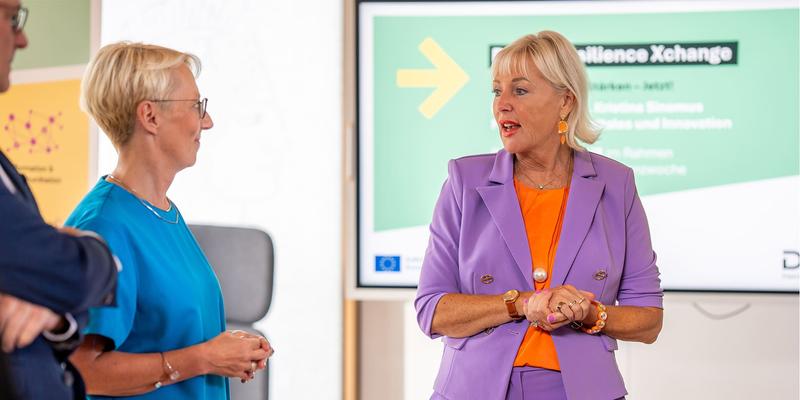
What happens when a city faces a power outage lasting several days? How can critical facilities continue to operate—and how can available energy be directed to where it’s needed most? Researchers at TU Darmstadt are testing answers to these questions with the eHUB on the Lichtwiese campus. Hesse’s Minister of Digital Affairs, Prof. Dr. Kristina Sinemus, visited the energy-self-sufficient building on September 7, 2026, during the first Hesse Resilience Week.
“A prolonged power outage must not paralyze cities. That is why we must develop and test solutions that work in case of a crisis. The eHUB clearly demonstrates how digital technology, renewable energy, and smart control systems can work together. These are exactly the kinds of solutions we need if we want to better protect critical infrastructure and make our state more resilient,” said the Minister.
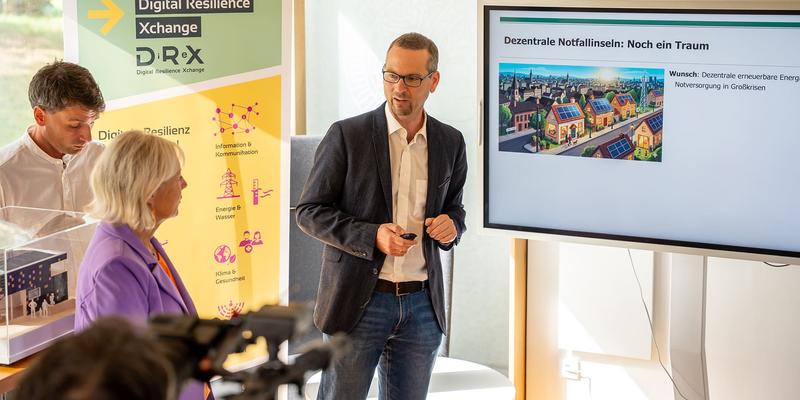
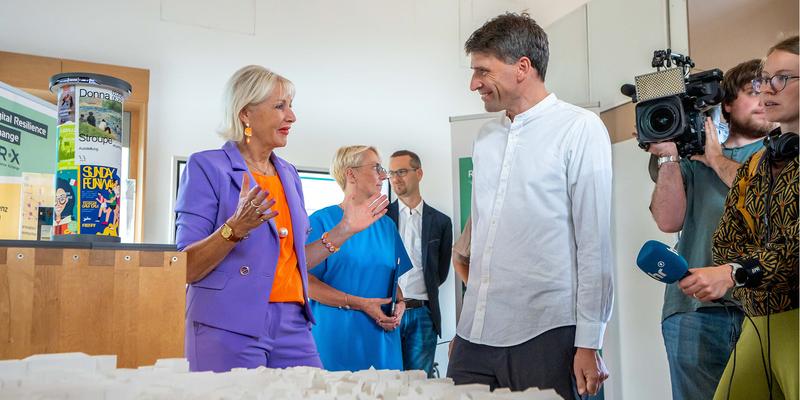
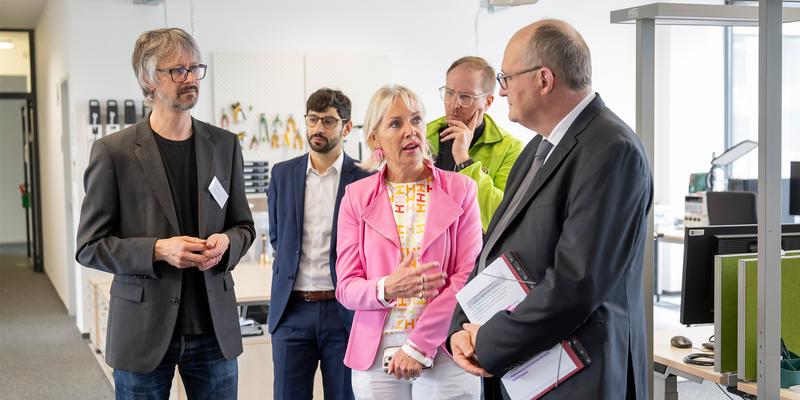
Digital Minister Sinemus (left) took a tour of the eHUB accompanied by the scientiests and various members of the press
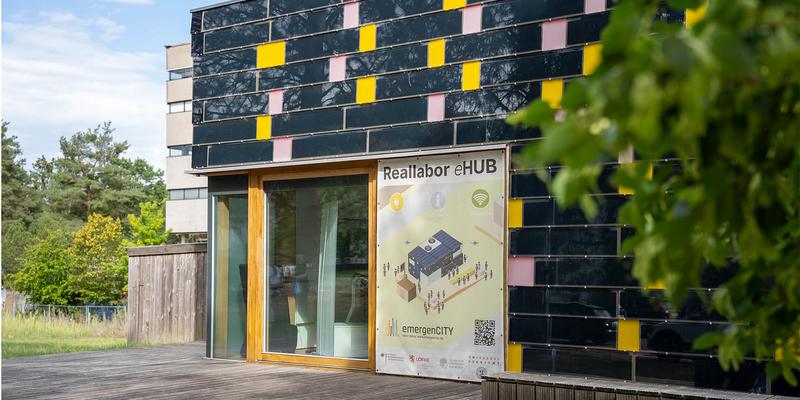
The eHUB is an energy-self-sufficient building that researchers at TU Darmstadt use as a real-world laboratory to test island grids for possible power outage.
An example of an island-capable power supply solution
In the event of a power outage, the eHUB can disconnect from the public grid and supply itself with power. To do so, it uses, among other things, electricity from a photovoltaic system. If the building produces more energy than it needs, it can also share some of it with the neighborhood or critical infrastructure. Many of the photovoltaic systems installed today are not designed to continue supplying power to their own buildings during a power outage. For safety reasons, they shut down automatically because the built-in inverters only operate in conjunction with the public power grid. The eHUB, on the other hand, can switch to an off-grid mode. In a crisis, it could become a hub for the public—not only to provide energy but also to receive important information about the current situation.
“In a crisis, eHUBs could form decentralized emergency networks that supply power to cell phone towers or traffic lights, for example. To make this possible, the technical and regulatory conditions must be established as quickly as possible,” said Prof. Dr. Florian Steinke, Professor of Energy Information Networks and Systems at TU Darmstadt and Principal Investigator at the LOEWE Center emergenCITY.
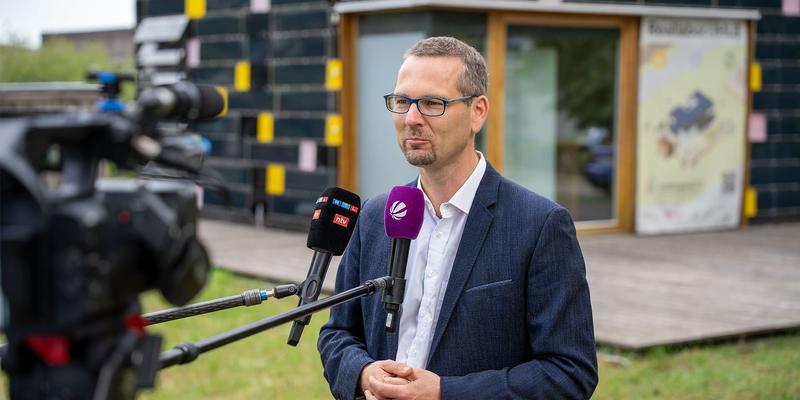
emergenCITY PI Florian Steinke answered the questions of the media representatives during the Minister's visit
From Research Findings to Applicable Solutions
These functionalities of emergenCITY’s eHUB were developed as part of the LOEWE center’s broader research into how cities and infrastructure can better navigate crises. Now, the Digital Resilience Xchange (DiReX) Application and Transfer Center is tasked with putting these findings of emergenCITY into practice more effectively. DiReX has been working to develop these decentralized solutions into a viable emergency supply system for times of crisis. In collaboration with policymakers, government agencies, critical infrastructure operators, and the scientific community, the application and transfer center is investigating how decentralized energy sources can be connected to form emergency networks and how available energy can be specifically allocated to particularly important functions during a crisis.
“Resilience is built before a crisis happens. We must ensure today that the population and critical infrastructure remain operational even during prolonged power outages. The eHUB demonstrates how decentralized, island-capable solutions can contribute to public preparedness and, at the same time, be used to provide emergency power to critical infrastructure in the event of a crisis,” said DiReX Director Prof. Dr. Michèle Knodt.
Digital Minister Sinemus in conversation with TU President Tanja Brühl
Ensuring Power Supply and Maintaining Society’s Ability to Function
The research around the eHUB involves, for example, determining what technical requirements are needed to make energy from decentralized facilities available in the event of a crisis: Which functions must be prioritized for power supply? How can communication infrastructure or other critical infrastructure continue to operate in an emergency? What criteria will be used to allocate scarce energy during a crisis? Will the public accept such prioritization decisions? And what regulatory conditions must be established today to make this possible?
“A secure energy supply is an essential prerequisite for our society’s ability to function. With the eHUB, TU Darmstadt demonstrates how research can contribute to practical solutions. Together with partners from politics and industry, we are testing and refining these solutions so that they can be deployed in the event of a crisis,” explained Prof. Dr. Tanja Brühl, President of TU Darmstadt.
Resilience Week in Hesse
From September 7 to 13, 2026, the first Hesse-wide Resilience Week takes place. With this initiative, the Hesse State Government aims to raise awareness of crisis preparedness and demonstrate how the government, the business community, and society can prepare for potential crises. This initiative is driven, among other things, by lessons learned from the COVID-19 pandemic, extreme weather events, acts of sabotage, and hybrid threats. Through the Hessian Resilience Strategy and the “Resilience Plan 2027,” the state government is working to make government and society more resilient.
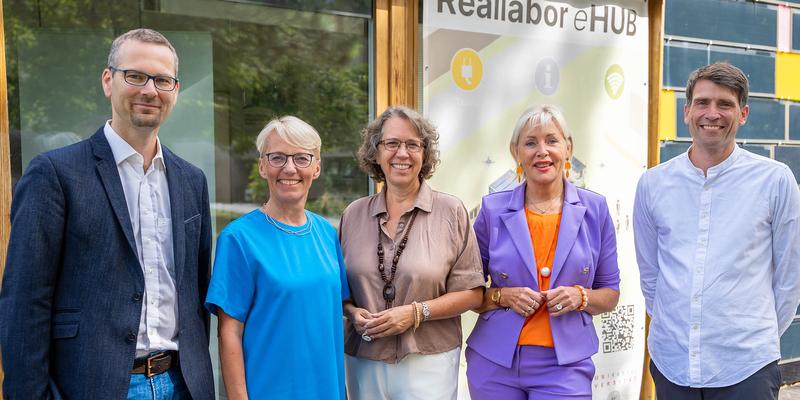
emergenCITY PI Florian Steinke, TU President Tanja Brühl, DiReX Director Michèle Knodt, and Joachim Schulze, Head of Real-World Labs at DiReX (from left to right), discussed urban resilience at the eHUB with Minister of Digital Affairs Kristina Sinemus (second from the right).
Share
Related News
International Visitors to the eHUB
Early-career researchers visit the emergenCITY real-world lab on the Lichtwiese campus on the initiative of...
Jun
29, 2026
Resilient Infrastructures of Digital Cities across Europe
Delegates from Darmstadt’s Sister Cities Visit the emergenCITY Lab
Jun
3, 2026
Media Response: A Look at the National Center for Digital Resilience
Hesse’s Minister for Digital Affairs, Prof. Dr. Kristina Sinemus, and the Minister of State for...