Oct
23, 2026
Media Coverage on the Resilience of the Power Supply
emergenCITY PIs Assess Attacks on Substations and the Security of Power Grids


emergenCITY PIs Assess Attacks on Substations and the Security of Power Grids
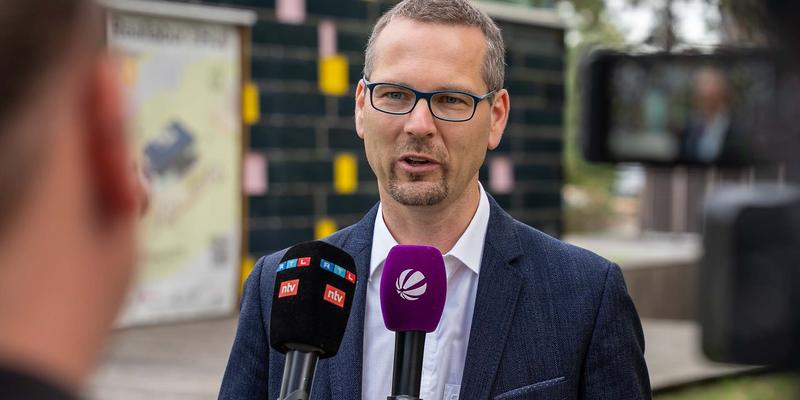
Following suspected acts of sabotage on substations in Brandenburg and North Rhine-Westphalia in early September, regional and national media discussed the security of Germany’s power supply. Experts from the LOEWE Center emergenCITY provided scientific perspectives in the coverage. The focus was on the protection of critical infrastructure, rapid recovery after damage, and decentralized, island-capable solutions for crisis situations.
emergenCITY PI Florian Steinke, Professor of Energy Information Networks and Systems at TU Darmstadt, pointed out in a statement for the Science Media Center Germany that the numerous facilities in the power grid can hardly be protected comprehensively against physical attacks. It is crucial to be able to repair damage quickly, for example with additional repair personnel and larger stocks of spare parts.
“We should therefore focus more on the ability to repair damage quickly,” Steinke told the Science Media Center.
As a further approach, Steinke cited decentralized emergency power islands, in which cities or neighborhoods disconnect from the transmission grid when it fails and temporarily supply themselves. emergenCITY is researching how this can work in its real-world lab, the eHUB - an energy-self sufficient and island-capable building.
On the tagesschau24 program “Update Wirtschaft” on September 11, cybersecurity expert and emergenCITY PI Christian Reuter spoke about the economy’s vulnerability to attacks on critical infrastructure. The power supply in particular poses a high risk of cascading effects, as almost all sectors depend on it. Critical functions therefore need fallback systems that can be controlled locally or operated offline, the researcher said. In the interview, he also presented TU Darmstadt’s research within emergenCITY and ATHENE.
The visit of Hesse’s Minister of Digital Affairs, Prof. Dr. Kristina Sinemus, to the eHUB on September 7 also attracted great media attention. As part of the first Hesse Resilience Week, Florian Steinke and Joachim Schulze, Head of Real-World Labs at DiReX, presented the island-capable building on the Lichtwiese campus to the Minister. On hessenschau, Steinke explained how existing photovoltaic systems could be used in a crisis:
“What we actually want to make possible is that when people equip themselves with solar systems and batteries as part of the energy transition, they can also use them in a crisis. A lot can already be achieved with the existing PV capacity. For example, we looked at cell phone towers for this purpose. Today, there is already a PV system within 300 meters of each one that would actually be capable of powering that cell phone tower, and now we just need to, so to speak, get the organization right,” Steinke said on hessenschau.
Speaking to SAT.1, Steinke emphasized that what is particularly new is connecting several small power islands into a larger one. However, further efforts are still needed, especially at the organizational level, before such solutions can be deployed on a broad scale.