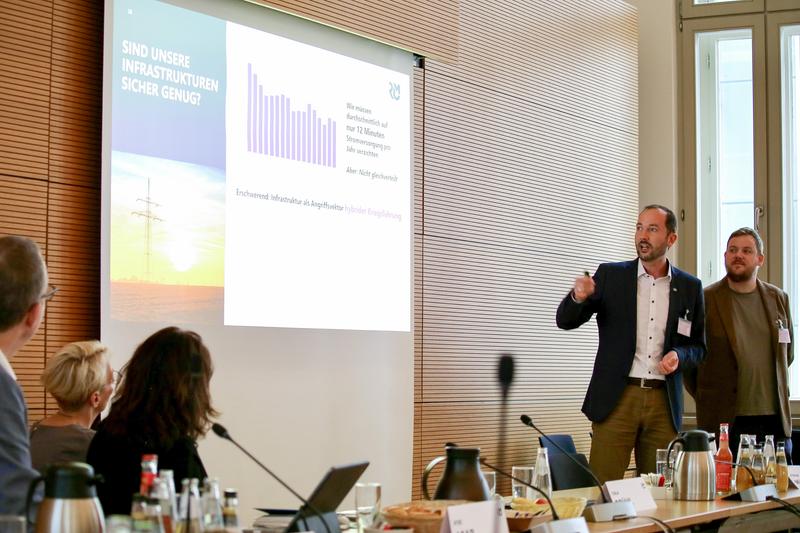
How resilient are democratic processes and the digital infrastructures our society depends on? On September 10, researchers from the Rhine-Main Universities (RMU) discussed this question with members of the German Bundestag. Under the title “Shaping Democracy - Strengthening Resilience,” the RMU had invited participants to a parliamentary breakfast in Berlin. Prof. Dr. Dr. Christian Reuter, member of the emergenCITY board of directors, and Prof. Dr. Florian Müller, associate Principal Investigator at emergenCITY, were also in attendance.
RMU spokesperson and TU Darmstadt President Prof. Dr. Tanja Brühl opened the event with a welcome address. She emphasized that a sustainable democracy needs two things: resilient institutions and reliable infrastructures. To ensure that scientific findings reach practice, the alliance relies on dialogue between science and politics.
Digital Infrastructures Under Pressure
In three short presentations, researchers from the RMU universities presented their current work. Dr. Susanne Garritzmann (Goethe University Frankfurt) and Dr. Nils Steiner (JGU Mainz) presented survey results on the state election in Saxony-Anhalt. Prof. Dr. Armin Schäfer (JGU Mainz) compared satisfaction with democracy in a European context. The third presentation focused on the technical foundations of society: Christian Reuter and Prof. Dr. Florian Müller (both TU Darmstadt) showed how vulnerable critical infrastructures are, particularly in the digital sphere, and how digital spaces can be manipulated. Hybrid threats and deepfakes served as examples. The two also presented options for action to strengthen digital sovereignty.
Research for Policy Questions
The researchers then held a discussion with the members of parliament, moderated by Dr. Patrick Honecker (TU Darmstadt). They discussed where policymakers are already taking action to protect democratic processes and critical infrastructures, and where research from the RMU can provide targeted support. Sören Heß, co-founder of the start-up Panocular AI, contributed the perspective of the RMU innovation ecosystem. Tome Sandevski presented the Mercator Science-Policy Fellowship Program, which he coordinates for the RMU. At the end, the participants agreed to continue the exchange.
More information: “Shaping Democracy - Strengthening Resilience” - TU Darmstadt and “Shaping Democracy - Strengthening Resilience: PEASEC Involved in Dialogue with Policymakers in the German Bundestag” - PEASEC - Science and Technology for Peace and Security, Technical University of Darmstadt