Jun
3, 2026
Resilient Infrastructures of Digital Cities across Europe
Delegates from Darmstadt’s Sister Cities Visit the emergenCITY Lab



Delegates from Darmstadt’s Sister Cities Visit the emergenCITY Lab
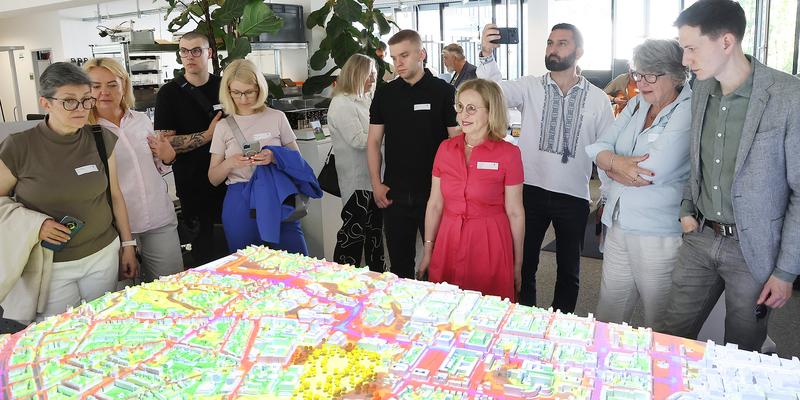
Given the diverse challenges cities around the world face today, the importance of urban resilience and crisis-proof infrastructure is growing. Accordingly, this year’s Europawochenende—an annual event to which the city of Darmstadt invites its sister cities—focused on the topic “Resilient Infrastructures of Digital Cities.” To kick off the weekend, the guests visited the emergenCITY Lab on May 29.
“With the Europawochenende, we foster professional exchange with our sister cities and live international friendships during the traditional,” said Mayor of Darmstadt, Hanno Benz.
To meet the multiple challenges, he noted, we must work beyond the boundaries of local governments. This year, representatives from Darmstadt’s sister cities Brescia (Italy), Chesterfield (United Kingdom), Graz (Austria), Gyönk (Hungary), Liepāja (Latvia), Nahariya (Israel), Płock (Poland), Saanen (Switzerland), Trondheim (Norway), and Uzhhorod (Ukraine) visited.
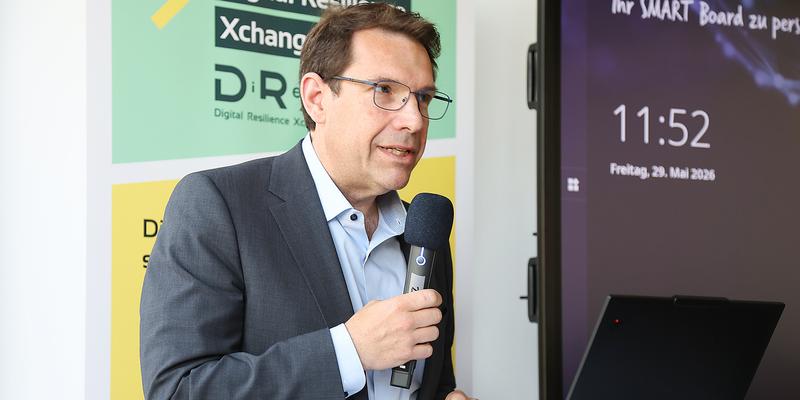
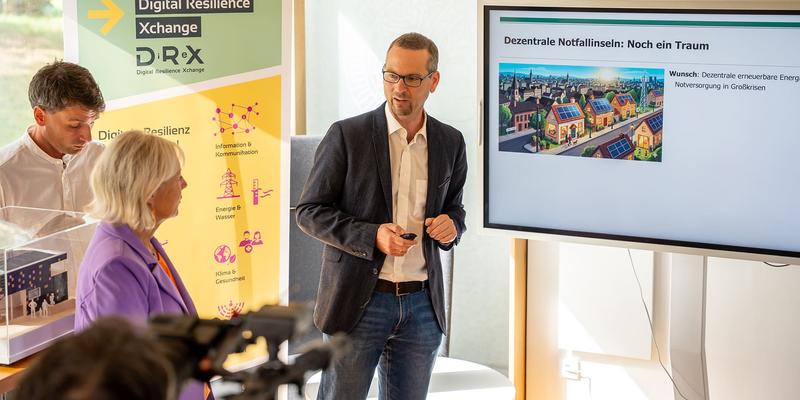
At emergenCITY Lab, researchers presented various demonstrators to the approximately 50 guests. Joachim Schulze, Head of Real-World Labs at DiReX, and Julian Euler, lab engenieer of the emergenCITY Lab, presented the Litfaßsäule 4.0, the eHUB, and the digital city model. The Litfaßsäule 4.0 is a self-sufficient warning column that can display warnings and information even during a prolonged power outage. The island-capable eHUB can share electricity with the neighborhood and critical infrastructure and serve as a hub during a crisis. The digital city model uses animated projections on a physical 3D model of the city of Darmstadt to visualize various dimensions of urban resilience.
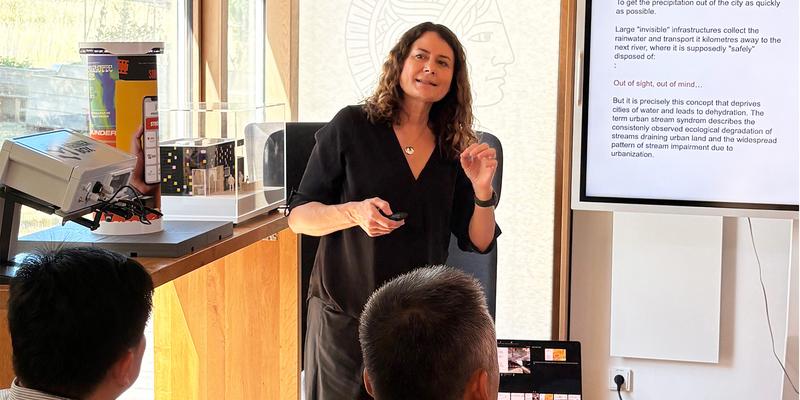
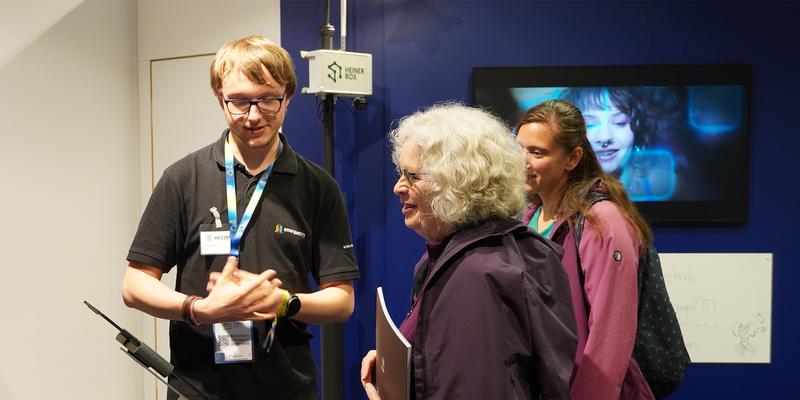
The program was complemented by a presentation by Michèle Knodt, deputy coordinator of emergenCITY and director of DiReX, on the topic of “Resilient Infrastructures of Digital Cities.” She presented further innovative research, including the Nebula consortium project, which develops demonstrators for detecting disinformation on social networks, and the Heinerboxes—sensor boxes developed at emergenCITY that collect environmental data locally in Darmstadt and could provide an emergency network during a crisis.
During an open Q&A session, the delegates discussed their digital strategies for strengthening resilience, the division of roles in crisis situations, data protection, and cross-municipal cooperation.
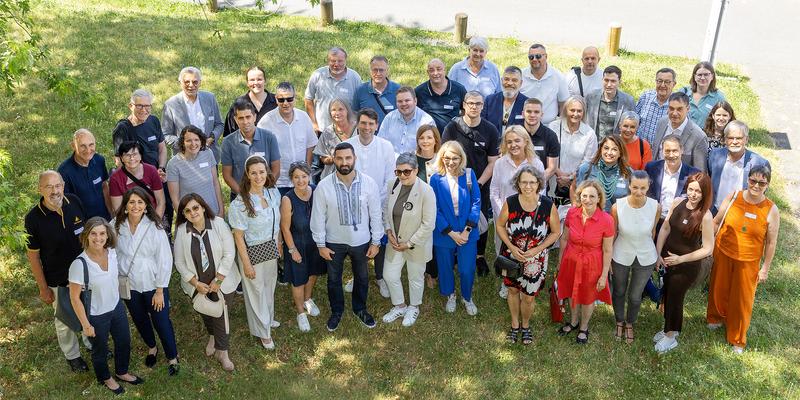
The visit by guests from across Europe was part of the official program for the Europawochenende in Darmstadt, which continues through May 30. In addition to expert discussions, the weekend includes other engagement activities such as an excursion to the European Space Agency’s (ESA) European Space Operations Centre (ESOC) and the traditional border walk with delegations from Darmstadt’s sister cities and citizens of Darmstadt.