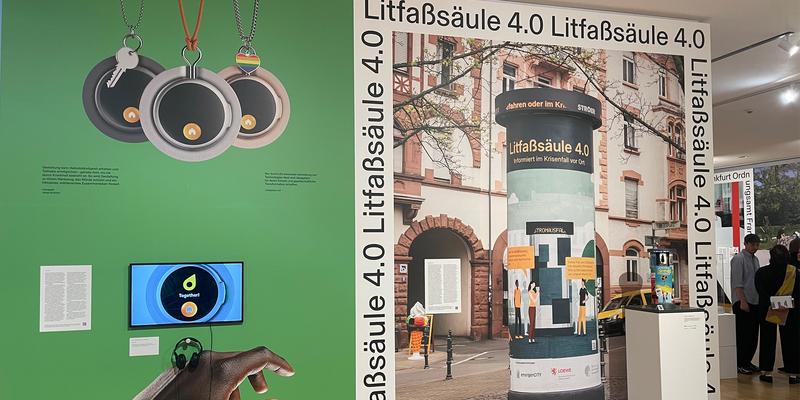
With the Litfaßsäule 4.0, emergenCITY researchers from the Department of Design and Urban Development at TU Darmstadt have transformed a familiar piece of public advertising infrastructure into a new tool for crisis communication. An additional display on the top of a regular advertising column can show information and warnings for the local population. Thanks to a fuel cell and solar panel, the column remains operational for up to 72 hours even in the event of a power outage.
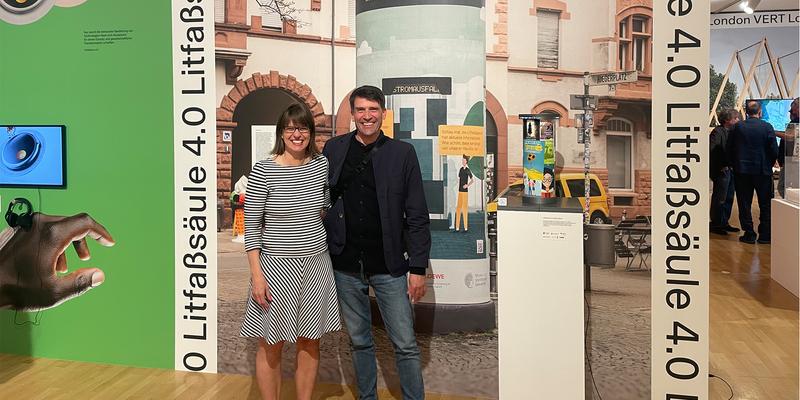
Originally planned from May 21 to June 28, now extended until August 9, the Museum of Applied Arts in Frankfurt is presenting the Litfaßsäule 4.0 in its exhibition Design for Democracy. What Design Can Achieve! as an example of how design can contribute to overcoming crises. The exhibition features a model of the column as well as photos of the prototype, which is located on Riegerplatz in Darmstadt.
Designing resilient infrastructure in an inviting way
When developing resilient infrastructure in cities, it is not only important that solutions function reliably in the event of a crisis. A key question is also how such technologies should be designed in public spaces so that they are used and embraced by the public.
“For me, the Litfaßsäule 4.0 demonstrates what design can achieve: It combines the analog character of a familiar public item with modern technology and translates this combination into a form that blends naturally into the urban landscape. This deliberate design fosters acceptance of new technologies and thus lays the foundation for societal transformation,” says Joachim Schulze, the architect in charge of the project.
About the exhibition
Design for Democracy. What Design Can Achieve!, curated by Anna Scheuermann and Prof. Matthias Wagner K, takes a broader look at the relationship between design and democracy based on 25 design examples from the Frankfurt Rhine-Main region and examines the effectiveness of good design. The exhibition is part of the program surrounding the *World Design Capital Frankfurt Rhine-Main 2026* award.