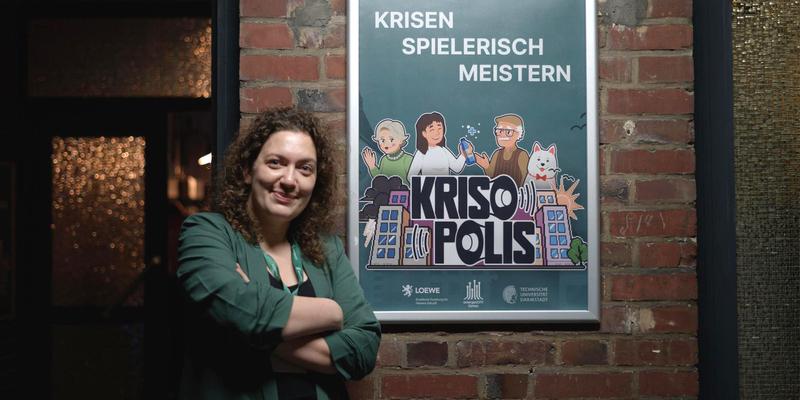
Nadja Thiessen studied history with a focus on modern history at TU Darmstadt. Since 2016, she has been conducting research in the Department of Modern and Contemporary History on critical infrastructure, crisis prevention, and urban resilience. As part of the KRITIS Research Training Group, she earned her Ph.D. with a dissertation on flood management in the 20th century. Since 2020, she has been a research associate at the LOEWE Center emergenCITY. There, she is involved, among other things, in the development of the serious game “Krisopolis.” Krisopolis was originally created as part of a bachelor’s internship, during which emergenCITY—and Nadja Thiessen in particular—took on a planning and coordinating role. Today, the game is firmly integrated into the Mission Serious Games initiative and was released in December 2025.
What was and is your role in the game’s development?
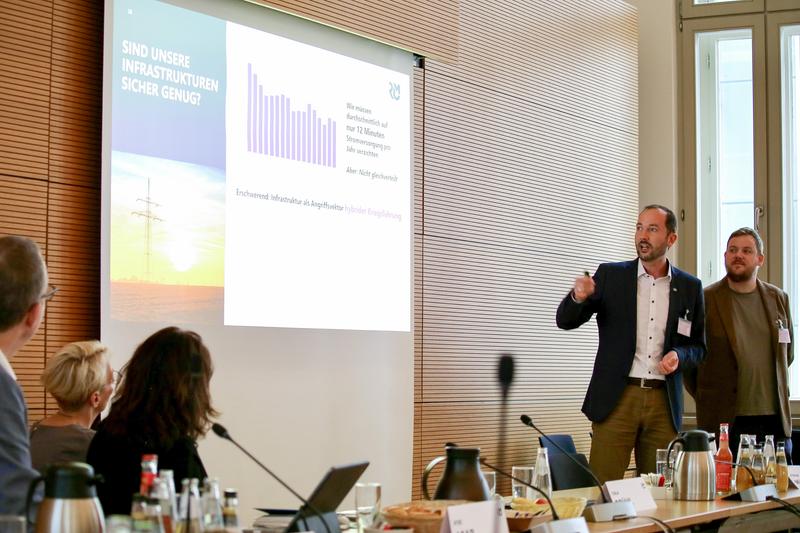
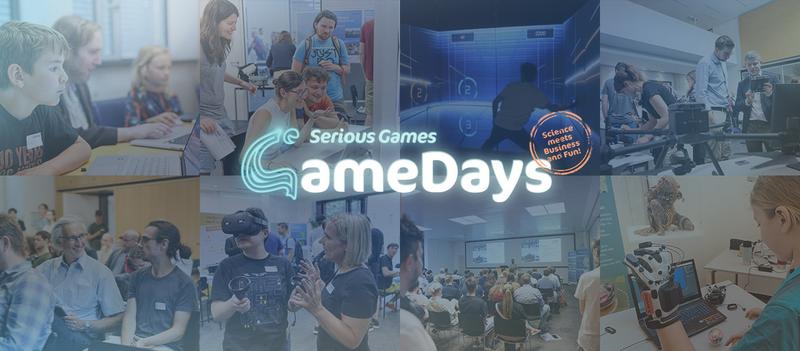
“In the early stages and during my bachelor’s internship, I mainly supported the students, planned, organized, and offered suggestions on which crises could be incorporated into the game—and what options players would have to respond to and overcome these crises. Once we had developed the first prototypes, I began presenting the game at trade shows and conferences. Among other events, we attended Gamedays, Hessentag, and the symposium on disaster preparedness.“
What part of game development do you enjoy the most? And the least?
“Definitely working as a team. Our interdisciplinary approach has always made it interesting. The students were very motivated and had great, creative ideas—for example, they even created the graphics and sounds themselves. For me personally, the best moment was when I got to try out our prototype on a phone for the first time. Being able to actually move my avatar for the first time, have conversations with my neighbors, and equip my backpack was incredibly fun. Seeing those ideas come to life was truly something special. Plus, it all happened so quickly: at that point, we’d only been developing the game for a few weeks. In contrast, the bureaucratic process right before the release was rather monotonous. We were more focused on things like registering a brand name or preparing for release on the Play Store and App Store.”
What is Krisopolis intended to inspire in players?
“My main goal was definitely to encourage a calm, unemotional discussion of crisis preparedness. Krisopolis aims to raise awareness in a playful way and, ideally, inspire people to take action—whether that means building their own stockpile or downloading a warning app. The emphasis on community in the game is also meant to highlight that, especially during crises, we should think of our fellow human beings.”
What do you mean by “unflappable”?
“No one should be scared of a potential crisis because of Krisopolis. The game aims to offer you a framework for solutions and suggestions on how to prepare, so that you don’t freeze up in an emergency. You can stock up on drinking water in advance, or think about what other ways you have to communicate if, for example, your cell phone stops working… It’s mainly the simple things— the ones that are relatively easy to do but are often forgotten in everyday life. Plus, you’re not alone in the game; the community works together to get through the crisis.”
Do you think the game achieves these goals?
“It certainly has the potential to do so. We’ve definitely put a lot of effort into introducing players to the topics of disasters and crisis preparedness in an accessible way. To that end, we’ve made the dialogues as humorous as possible, but we’ve also included links to the official websites and information from the Federal Office for Civil Protection and Disaster Assistance, for example, in case anyone wants to learn more.”
Is there a particular group of people you’d especially like to see playing Krisopolis?
“In particular, all the people who don’t read traditional self-help books—perhaps because they don’t have the time—but who enjoy games and want to engage with the topic during, say, a short tram ride. To reach them, we’re specifically trying this new approach. But of course, we’re also very happy when children and teenagers play Krisopolis.”
As recently as March, Interior Minister Dobrindt called for the integration of civil defense and crisis preparedness into school curricula. Should institutions such as schools make targeted use of Krisopolis for this purpose to promote education, or should it rather be a tool that people discover on their own and use individually for their own benefit?
“Ideally, both! Incorporating the topic into lessons—and especially playing the game together as a class—is a great way to help children and teens delve deeper into the subject. Students can then share what they’ve learned with their families, play the game together at home, and discuss their own personal disaster preparedness. Of course, they can also do this on their own.”
What current approaches are there for integrating the game into the classroom?
“Together with the agency quäntchen + glück, we are currently assessing exactly what teaching materials educators need. In doing so, we are also determining how to make the game accessible in a way that makes it appealing to teachers. In general, Krisopolis fits well with most subjects. Civil protection is a cross-curricular topic and can actually be integrated into any subject. Club activities would also be a good option: in Baden-Württemberg, one school has already established a club on civil protection in collaboration with the Workers’ Samaritan Federation.“
What was your experience of the celebrations for the release of Krisopolis last December?
“They were amazing! It was incredibly moving. With the current core team—Jakob, Katharina, and Joachim—we had the chance to look back on how it all began—and it was so wonderful to see what it has become. I was especially happy that some of the original Krisopolis developers were there, and of course the many other Krisopolis enthusiasts… The best moment was when we were able to announce on stage that Krisopolis is now available for free download.”
Even though the game has been released — does it actually feel “finished”?
“With Krisopolis, it’s just like with books or articles. Even if it’s technically finished, it doesn’t quite feel that way. Above all, so many new ideas keep coming up—we’re getting more and more ideas from feedback. So there’s still room to grow!”
Is there anything else you’d like to incorporate into the game?
“Yes! Soon there will be even more storylines and secrets about the residents of Krisopolis to discover in the game, and down the road I could imagine adding a kind of training mode. Currently, crises are triggered randomly, but in a training mode, you could select a specific crisis and prepare for it as best as possible in order to handle it effectively.”
What’s next for you after Krisopolis?
“The release isn’t the end. In addition to the educational materials, we’re working on a few updates, and we’ll continue to participate in trade shows and workshops. For example, on April 22, I’ll be presenting Krisopolis at the E-Learning Roundtable hosted by the Center for Teaching and Learning at TU Darmstadt. For me personally, Krisopolis has introduced me to a truly fascinating topic: serious games. I hadn’t had much experience with digital games before, but I believe this approach can significantly boost the resilience of the population. In the remaining months at emergenCITY, I plan to continue my research alongside Krisopolis.
In the long term, I could see myself exploring other aspects of knowledge transfer using serious games. We’ll definitely keep an eye out for funding opportunities for future projects.“