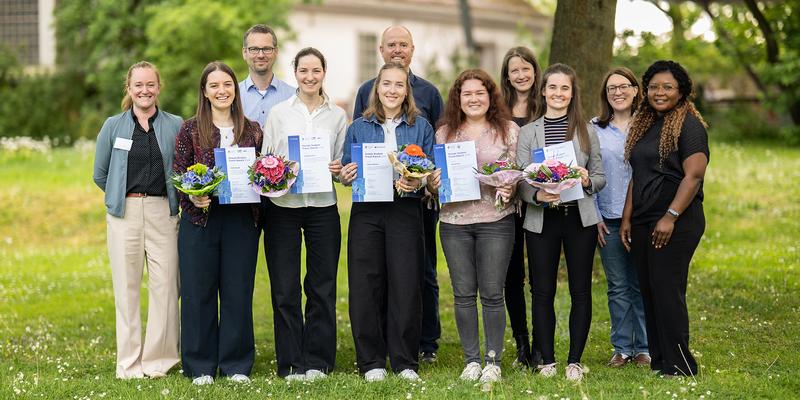
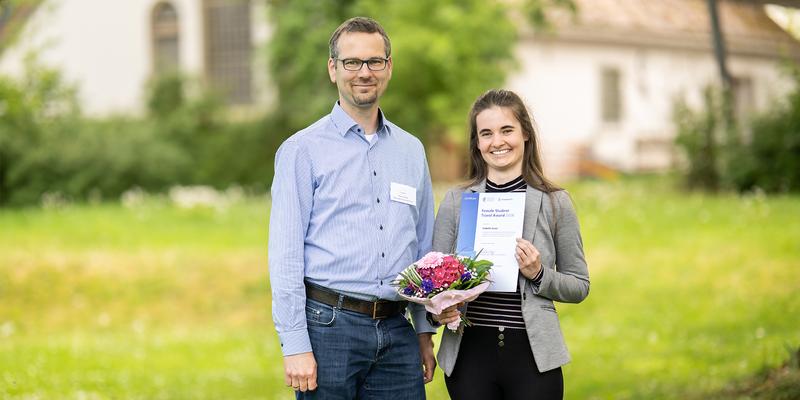
This year’s emergenCITY Week concluded on May 8 with the presentation of the 2026 Female Student Travel Award. The award was handed over jointly by the CROSSING Collaborative Research Center, the LOEWE emergenCITY Center, the Hessian Center for Artificial Intelligence (hessian.AI), and the Reasonable AI (RAI) Cluster of Excellence to six female master’s students at TU Darmstadt. This year’s award recipients are: Michelle Geisler (M.Sc. in Cognitive Science and M.Sc. in Mathematics; emergenCITY), Jacqueline Koch (M.Sc. in IT Security; CROSSING), Daniela Risis (M.Sc. in Computer Science; RAI), Gözde Saçıak (M.Sc. in Computer Science; CROSSING), Isabelle Sauer (M.Sc. in Computer Science; emergenCITY), Leonie Schüssler (M.Sc. in Artificial Intelligence and Machine Learning; hessian.AI).
emergenCITY Award Winner Isabelle Sauer
Isabelle Sauer is pursuing a master’s degree in computer science at TU Darmstadt. Her bachelor’s thesis dealt with Riotee, a battery-free open-source platform for the Internet of Things, a project led by emergenCITY Professor Marco Zimmerling. Powered by solar panels, the system is more sustainable and resilient than battery-powered alternatives because it is energy self-sufficient. One area of interest she would like to explore further is hardware security.
“During my master’s program, in addition to the intersection of computer engineering and computer networks, I also focused on the intersection with IT security and took courses such as Embedded Systems Security and Physical Attacks and Countermeasures.”
– Isabelle Sauer
But securing and connecting devices while keeping energy consumption low isn’t the only challenge Isabelle Sauer is tackling. While it was nothing out of the ordinary for her to begin her bachelor’s degree in computer science, she realized during her studies that the vast majority of lectures were taught by male professors. Even while working on her bachelor’s thesis and during a research stay abroad, there were no women on her team with whom she could have networked.
“Now I also want to become a role model and be visible. I want to become a woman in technology and research, because I’m convinced that the more women who choose this path, the less unconscious bias there will be. And even if I may have to work to ensure that my research is valued just as much as men’s, hopefully it will be easier for girls in future generations.”
– Isabelle Sauer
emergenCITY Award Winner Michelle Geisler
Michelle Geisler is pursuing a dual degree program, earning a master’s degree in mathematics on the one hand and a master’s degree in cognitive science on the other. For the LOEWE Center emergenCITY, she helped develop the serious game Krisopolis, which uses accessible methods to teach topics related to crisis prevention and disaster management.
“My main interest is researching human learning processes and problem-solving. I find serious games, such as Krisopolis, to be a particularly exciting tool for this. Otherwise, I spend a lot of time working on theoretical models of human thinking and problem-solving—models that are too applied for most mathematicians and too mathematical for most cognitive scientists.”
– Michelle Geisler
For Michelle Geisler, it would be a dream come true to be able to study for a few more years as part of a doctoral program—or perhaps even to teach. Since the cognitive sciences in particular place a strong emphasis on practical research experience, participating in a summer school represents a great opportunity.
“Thanks to this award, I have the opportunity to travel to Prague for ESSLLI 2026, a two-week summer school with an interdisciplinary focus on mathematics and cognitive science. I hope to network with young researchers who are at the same stage in their careers as I am, or who are a few steps ahead. That way, I’ll at least find like-minded people to exchange ideas with, and ideally even role models and mentors for a potential Ph.D.”
– Michelle Geisler
About the Female Student Travel Award
The Female Student Travel Award honors female students from all disciplines at TU Darmstadt who have demonstrated outstanding academic achievement and whose academic interests are clearly aligned with the research topics of the participating consortia, whether in cybersecurity, resilient urban infrastructure, or artificial intelligence. The award enables the winners to attend a leading international conference that brings together women in computer science and engineering. For the first time this year, all award recipients also have the opportunity to attend a scientific conference. This initiative reflects the shared commitment of the participating networks to provide female students with early access to the research community and to encourage them to pursue future careers in research.
Ruzena Bajcsy Lecture
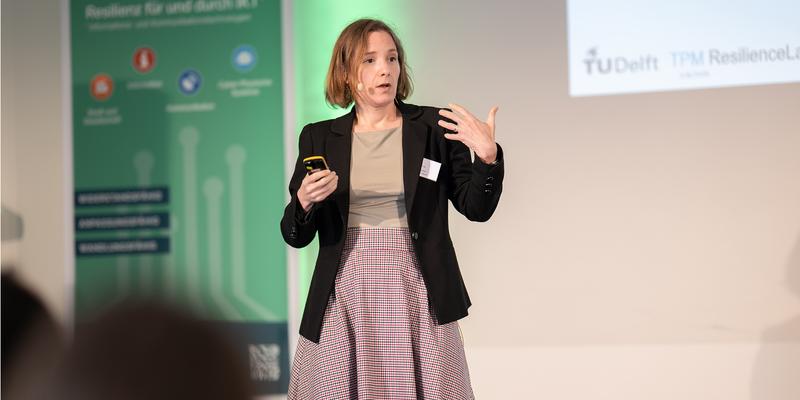
Traditionally, the Female Student Travel Award is presented following the Ruzena Bajcsy Lecture. This year, Prof. Dr. Tina Comes (Delft University of Technology), a member of the emergenCITY Scientific Advisory Board, presented her research on AI and decision support in crisis management. In her presentation, the professor outlined an empirically grounded approach to developing decision support systems for civil protection and humanitarian aid, based on field studies conducted in Europe, Asia, and Africa.