In today’s interconnected society, digital communication is ubiquitous. If mobile networks and the internet fail, the consequences can be devastating, especially in crisis situations: emergency responders struggle to coordinate, and the affected population receives no information or messages. The emergenCITY mission Extreme Communication (ExCom) is therefore developing resilient communication solutions that can be deployed reliably and flexibly without pre-existing infrastructure.
Reliable Message Delivery with Flying Communication Nodes
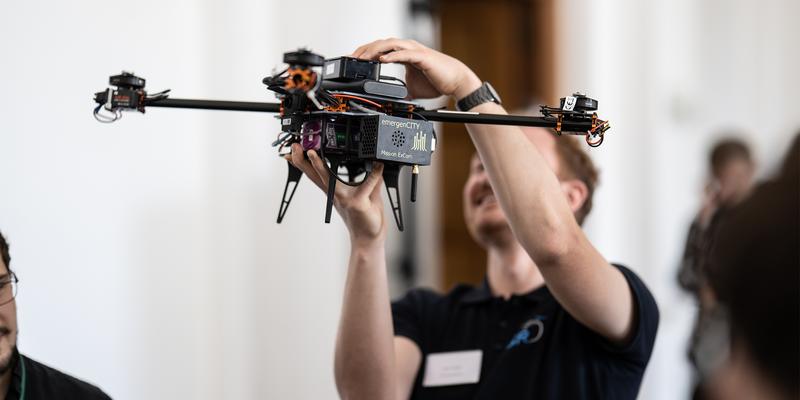
The researchers combine delay- and disruption-tolerant networks (DTN), Long Range (LoRa) radio technology, and conventional Wi-Fi with satellite communication as well as unmanned aerial vehicles (UAVs) to set up an independent and dynamic crisis network in disaster areas. The UAVs act as flying communication nodes that collect and deliver messages fully automatically as soon as a connection is possible. The focus here is not on fast, but on reliable transmission, following the premise: “A late message is better than no message at all.” After all, lost messages can have life-threatening consequences for emergency response teams and the population.
The mission is designed and carried out in close collaboration between the two emergenCITY program areas Communication and Cyber-Physical Systems. In terms of its focus, it builds on the findings of the emergenCITY missions Aerial Crisis Networks (ACN) and ReSON and transfers their concepts into operational crisis scenarios.
“UAVs and wireless communication are key technologies for a resilient society. We have already demonstrated this in several scientific publications within the framework of emergenCITY in recent years. With the ExCom mission, we are now putting this knowledge into practice and testing our concepts under real-world conditions,” says mission lead Robin Müller from the Institute of Flight Systems and Automatic Control (FSR) at TU Darmstadt.
Messages successfully transmitted during first tests
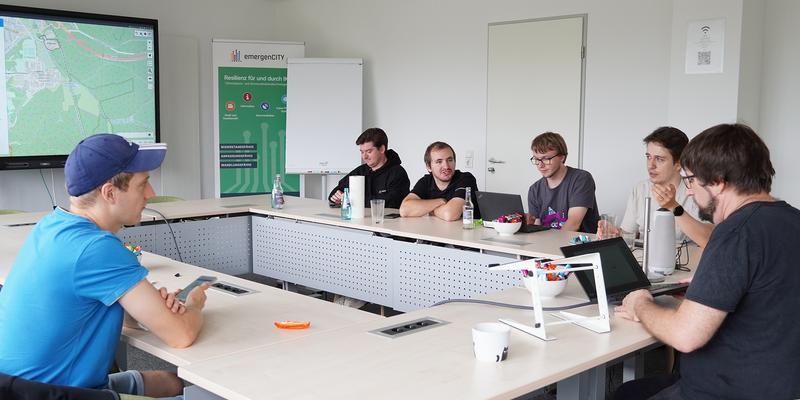
The first test flights have already been successfully completed. Using a custom-developed DTN app, the mission team sent and received text messages—independent of external networks—between two stationary DTN hubs on the ground that were periodically passed over by a UAV. The team of researchers, which includes Robin Müller, Hendrik Wingbermühle, Jonas Franz, and Vincenz Mechler, is now working on publishing a dataset. In the future, the targeted use of satellite communications as a fallback channel will also be examined.
“Prospectively, we will test innovative approaches for future satellite communications to further optimize ExCom for large-scale crises,” says Matthias Hollick, scientific coordinator of emergenCITY and member of the ExCom mission.
For further information about the mission, visit the new website.