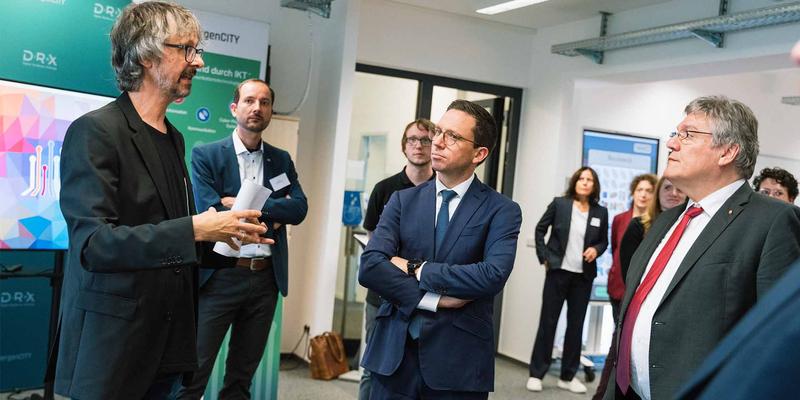
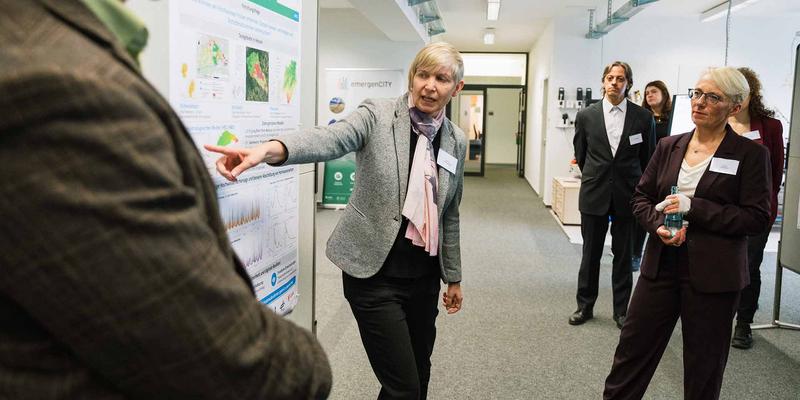
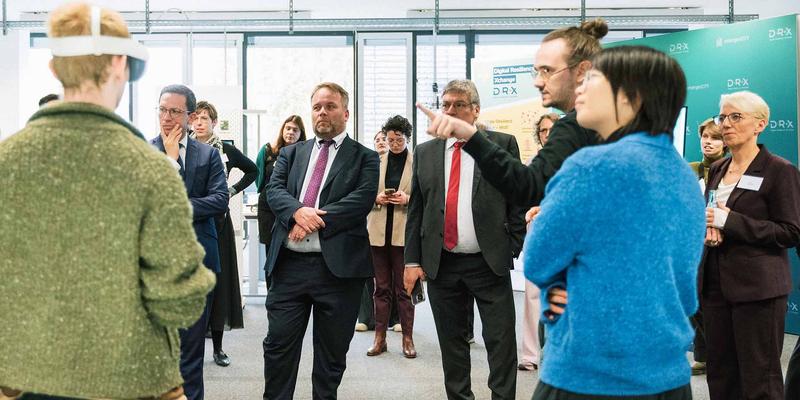
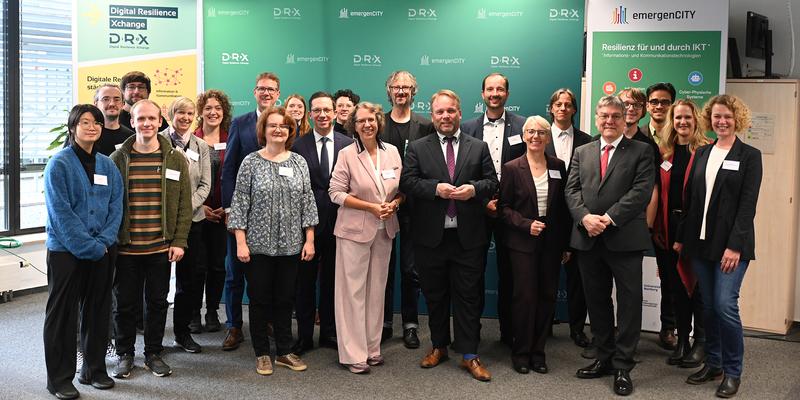
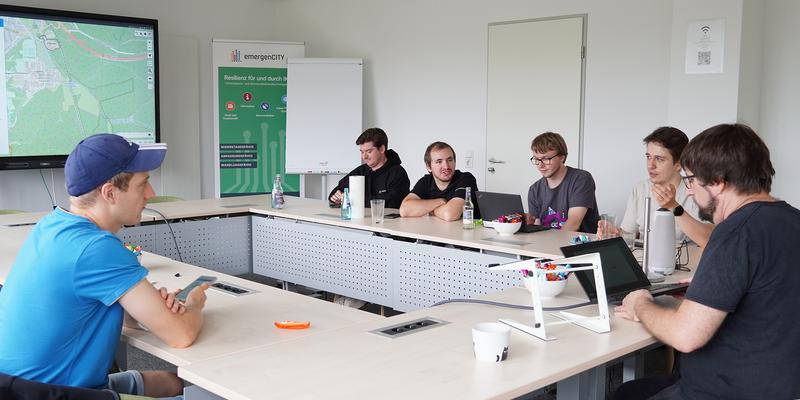
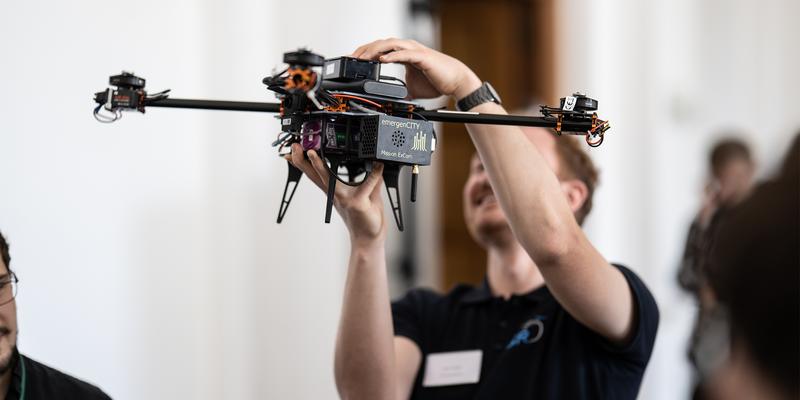
Today’s cities are interconnected digitally—and those of the future will be even more networked prospectively. Critical infrastructure in sectors such as energy, transportation, and healthcare is increasingly dependent on information and communication technologies. The solutions developed at emergenCITY help make cities resilient, even in the event of unforeseen and complex crises. During the minister’s visit, eleven researchers presented their latest findings and demonstrated their practical applicability.
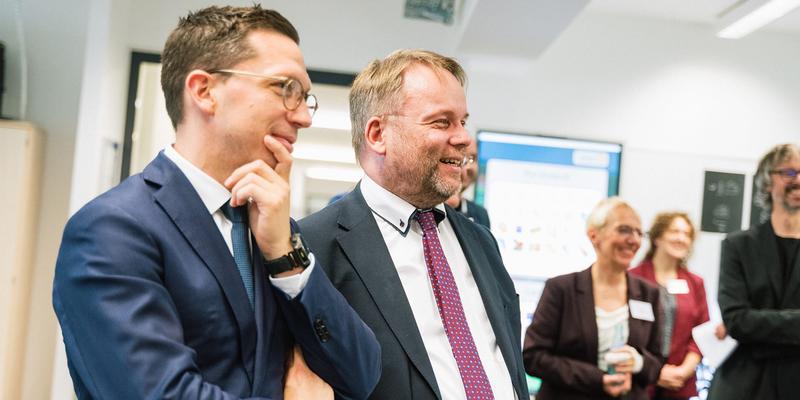
“At emergenCITY, researchers are working on solutions that ensure emergency operations during crises and enable rapid assistance and a return to everyday life. The project thus powerfully illustrates the vital role our universities and non-university research institutions play in addressing the challenges of our time. I am particularly impressed by the steady stream of innovations over the past seven years and by the fact that the research does not remain confined to the laboratory. Rather, concrete solutions are being tested on site in cities in Hesse with the involvement of the local population. This enables us to sustainably increase the resilience of urban societies in Germany and beyond,” said Timon Gremmels, Hesse’s Minister for Science and Research, Art, and Culture.
Falko Mohrs, Lower Saxony’s Minister of Science and Culture, welcomed the exchange between the two federal states:
“The major issues of the future do not stop at state borders. That is why we need strong collaboration between Germany’s scientific institutions. Lower Saxony and Hesse are already working together successfully in this regard. emergenCITY impressively demonstrates how excellent research can help harness the opportunities of digitalization and artificial intelligence for the benefit of people and make our society ready for the future.”
“emergenCITY exemplifies how we, as a technical university, build long-term expertise that our society needs to remain capable of taking action even in crisis situations. In doing so, we rely on interdisciplinary cooperation and exchange with partners in the field. Funding from the State of Hesse’s LOEWE program has laid the foundation for long-term structures. I am pleased that emergenCITY is continuing its work as an interdisciplinary scientific platform under the leadership of TU Darmstadt—and, together with strong partners, is continuing to develop forward-looking solutions for crisis-resilient digital cities,” said Prof. Dr. Tanja Brühl, President of the Technical University of Darmstadt.
From Flood Prediction to Crisis Communication with AI: A Wide Range of Topics and Solutions
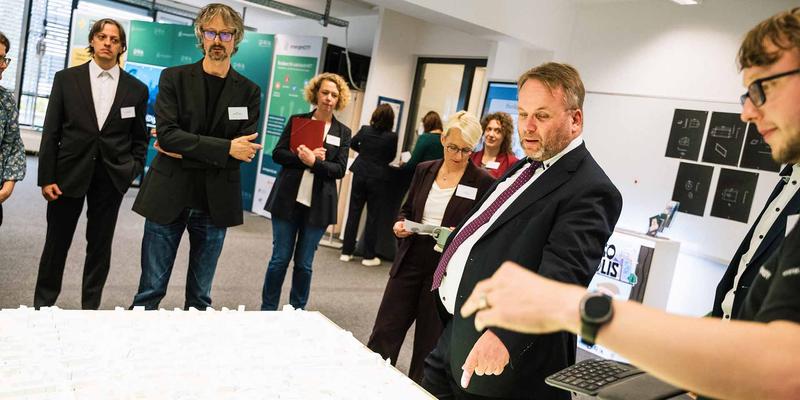
The emergenCITY researchers presented a series of current research findings to the ministerial delegation. The examples presented ranged from the Heinerbox—a sensor box which measures environmental data and provides a test bed for resilient crisis communication on-site in Darmstadt, to the mobile serious game Krisopolis, which allows users to practice crisis preparedness, and ShadAR, an augmented reality tool supported by artificial intelligence (AI) that can highlight important information—for example, for emergency responders—in their field of view.
Prof. Dr. Dr. Christian Reuter provided an overview of how vulnerable critical infrastructures are to hybrid threats and presented options for action that would strengthen digital sovereignty in Germany. Prof. Dr. Britta Schmalz and Dr. Mohsen Dehghani Darmian presented hydrological models that use AI to improve the prediction of flood patterns, and Prof. Dr. Iryna Gurevych, together with Dr. Thomas Arnold, demonstrated how the trustworthiness of texts co-produced by humans and AI can be fully traced to prevent misinformation in applications with high security requirements.
Research on Digital Resilience Continues within New Structures
Prof. Dr. Matthias Hollick, scientific coordinator of LOEWE-emergenCITY, summarized:
“LOEWE-emergenCITY investigated resilience for and through information and communication technology. Through our basic research, we were able to demonstrate how the resilience of cities and society as one can be enhanced through the use of technology. Even after the LOEWE funding has ended, our work continues. We will investigate current topics such as satellite communications, robotics, and artificial intelligence from a resilience perspective and continue to promote the socially important topic of digital resilience by operating an office and a showroom.”
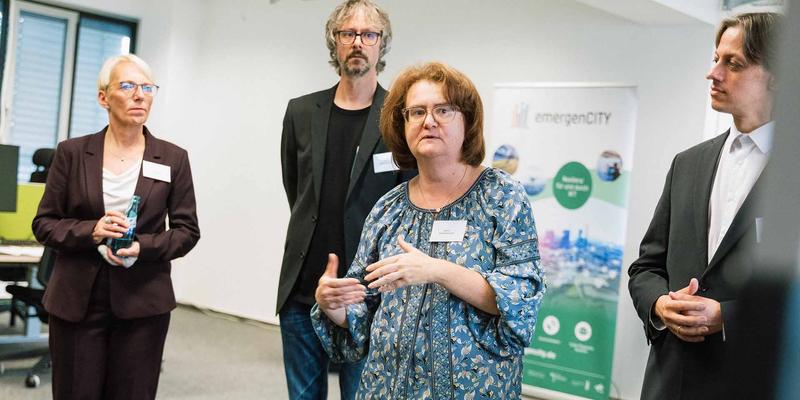
Prof. Dr. Michèle Knodt presented the work of the Digital Resilience Xchange (DiReX) Application and Transfer Center, which is further transitioning various demonstrators and real-world labs from emergenCITY into practice. She also provided an outlook on a Resilient Critical Infrastructure Lab, which could potentially be established as part of the newly approved EXCITE Network of Excellence of the Rhine-Main Universities (RMU).
Basic research from the LOEWE Center will also continue. Applications have been submitted for two DFG Research Training Groups to further investigate adaptive critical infrastructures and to examine human-AI collaboration in critical application contexts. Research is also continuing in the field of information and communication systems within national and international consortia, for example in the area of satellite communications.