


Extreme Communication
Today, digital communication and connectivity are ubiquitous. An outage, especially during a crisis, can therefore be even more devastating. Without a functioning digital network, emergency responders struggle to coordinate, and the public is left in the dark. The Extreme Communication (ExCom) mission is developing resilient communication networks for extreme situations. The goal: Even if conventional global networks such as the Internet or cellular networks fail during crises, emergency responders and the affected population should be able to exchange information and data locally. Among other things, ExCom is conducting research into how a robust crisis network can be established using various wireless technologies and by utilizing satellites and drones as airborne communication nodes. The mission builds on findings from the emergenCITY ACN and ReSON missions regarding disruption- and delay-tolerant networks (DTN).
Contact Us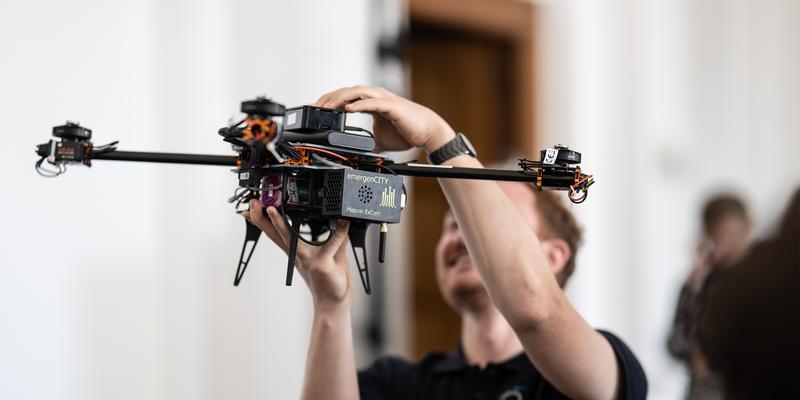
Research Question
How can we provide communication under extreme conditions to efficiently and rapidly resolve crisis scenarios?
The researchers expect significantly more challenging conditions and are placing a strong emphasis on the robustness of the developed system. The aim is that it can be deployed reliably and flexibly in disaster areas—with minimal configuration effort and without relying on existing infrastructure. To this end, ExCom combines disruption-tolerant networks (DTN), Long Range (LoRa) wireless technology, and conventional Wi-Fi with highly automated drones (UAVs) and using satellite communications. The focus is not on fast transmission, but on reliable transmission of messages, based on the premise that “a late message is better than no message at all,” since lost messages can have life-threatening consequences for response teams and the population. If no direct communication link is available between two locations, information must be physically transported. The goal is to establish a dynamic drone network over a disaster area that collects messages fully automatically and ensures their transfer. The drones simultaneously serve as mobile nodes in a mesh network, which also allows direct communication if sufficient nodes are available. This combination of a multimodal communication system, its integration into unmanned aerial systems, and specific flight control strategies gives the ExCom mission a highly innovative character. The mission is being designed and carried out in close collaboration between the emergenCITY CPS and KOM program areas.
Program Areas in the Mission
Communication (KOM)
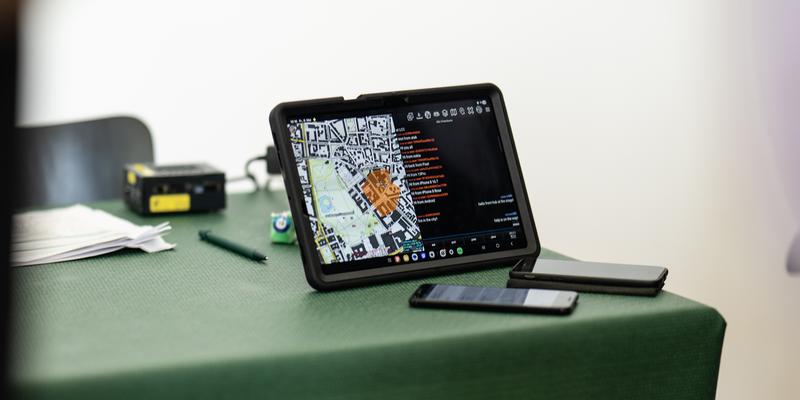
The KOM program area develops wireless communication methods for extreme operating conditions. The focus is on developing a LoRa-based connection between UAVs, ground stations, and other local communication nodes, as well as delay-tolerant message exchange between user devices. The targeted use of satellite communications as a fallback channel is being evaluated. This is complemented by channel-aware routing, which makes optimal use of the available bandwidth under changing conditions. The goal is to provide long-range emergency communication that is available to emergency responders as well as the civilian population without the need for an internet connection, a cellular network, or pre-installed infrastructure.
Team: Björn Scheuermann Hendrik Wingbermühle Jonas Franz Vincenz Mechler Bastian Bloessl Matthias Hollick
Cyber-Physical Systems (CPS)
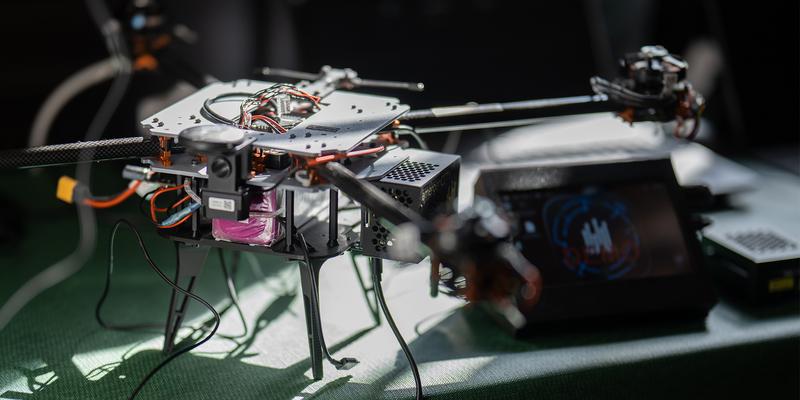
The CPS program area is responsible for intelligent flight planning, the human-machine interface for flight control, and UAV system integration. Using AutoAPMS—a framework for modeling and executing automated processes in robotic systems—mission commands are efficiently encoded and transmitted wirelessly via LoRa-Link, enabling the drones to dynamically adjust their flight behavior as needed. A load-controlled flight planning algorithm ensures that UAVs are deployed in a resource-efficient way where communication needs are highest. The concepts were validated in field trials, and automated flight operations were tested.
Team: Robin Müller Uwe Klingauf