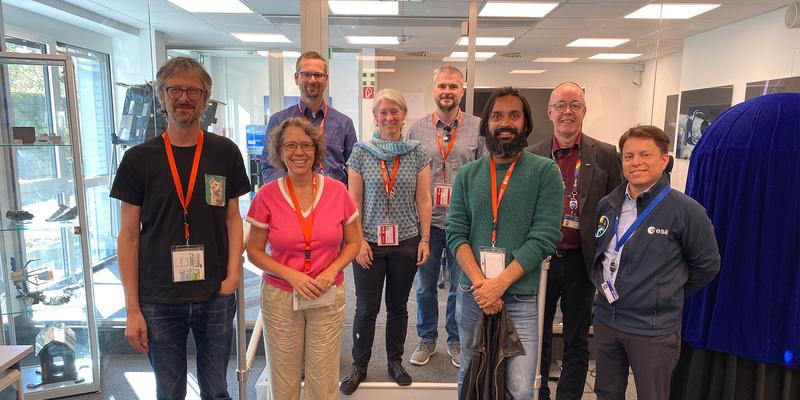
What impact does solar activity have on our highly technological society? And how can critical infrastructure on Earth be protected from potential disruptions caused by space weather? A team of scientists from the Technical University of Darmstadt addressed these questions during a visit on October 1, 2025, to the European Space Operations Centre (ESOC) of the European Space Agency (ESA) in Darmstadt.
Space weather refers to the sun’s activity and its impact on the Earth’s immediate environment. In addition to impressive auroras, this can also include powerful solar storms, that is, eruptions of plasma and electromagnetic radiation, which can significantly affect power grids, satellite communications, and navigation systems. During the visit to ESOC, Matthias Hollick and Michèle Knodt from the emergenCITY directorate, as well as emergenCITY Principal Investigator Florian Steinke and the two emergenCITY research associates Avikal Somvanshi and Julian Zobel, gained insights into the work of ESA’s Space Weather Office.
In a discussion with Juha-Pekka Luntama, Head of the Space Weather Office at ESA, and Jorge Amaya, Space Weather Modeling Coordinator at ESA, the researchers explored how findings from space research can be used to protect Earth-based systems. The focus was particularly on more precise early-warning systems, approaches to data analysis, international cooperation, and strategies for dealing with potential disruptions caused by space weather. Continuous monitoring of solar activity is crucial for identifying risks early and mitigating their effects.
In the future, the researchers plan to further deepen their collaboration with ESA. The goal is to translate scientific findings more effectively into practical applications, thereby increasing the resilience of modern infrastructure against natural hazards originating in space.