Feb
12, 2026
Working Together for a More Resilient Hesse
Members of the Hesse Green Party’s State Parliamentary Caucus Visits emergenCITY and DiReX in Darmstadt.



Members of the Hesse Green Party’s State Parliamentary Caucus Visits emergenCITY and DiReX in Darmstadt.
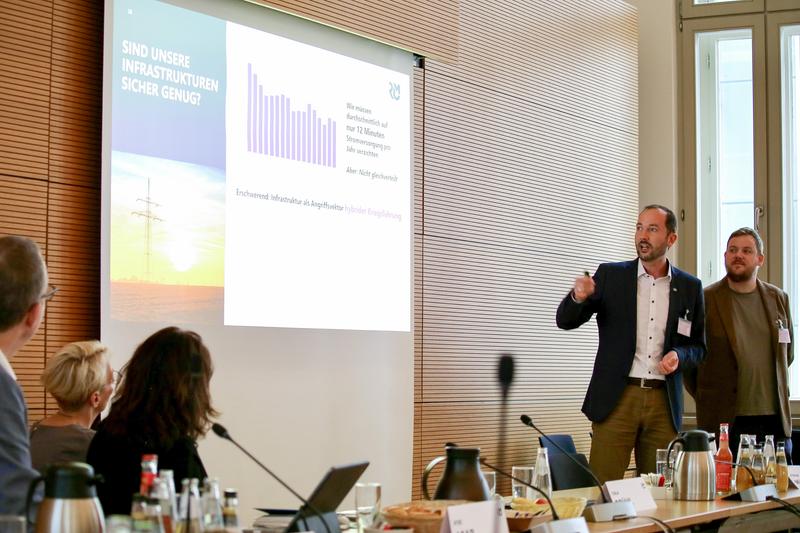
Widespread power outages in recent years—most recently in Berlin—have highlighted one of the biggest challenges during crises: it is not just the technical failure itself, but the need to provide the public with timely and reliable information. When digital communication channels fail, uncertainty, rumors, and coordination problems arise.
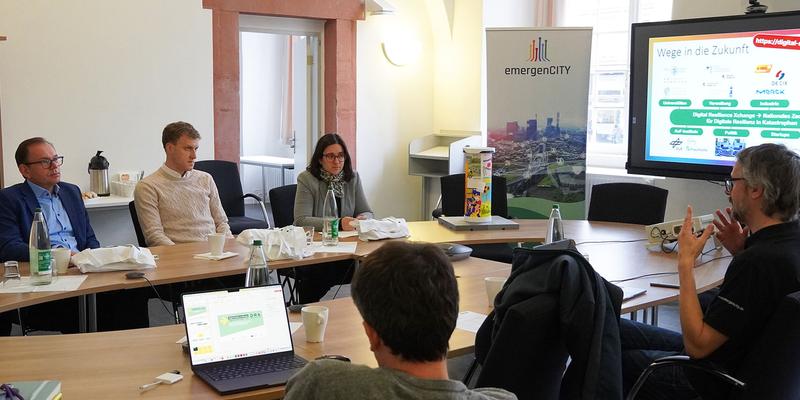
This is precisely where the work of the LOEWE Center emergenCITY and the Digital Resilience Xchange (DiReX) Application and Transfer Center comes into play. Four representatives of the Hessian state parliamentary group of Bündnis90/Die Grünen recently visited the Technical University of Darmstadt to see firsthand how research is being translated into concrete tools for disaster management.
Using the Heinerboxes, Matthias Hollick, scientific coordinator of emergenCITY, demonstrated how they can make climate and traffic data visible to citizens while also serving as a resilient information hub in crisis situations. Following the successful installation of all the boxes in the Lichtenbergblock in Darmstadt, the test phase is now underway. Soon, citizens will also be able to track the measurement data in real time.
Another key focus was the Litfaßsäule 4.0. As a pilot project in Darmstadt, it addresses precisely the problem that arises time and again in real-life crisis situations: How do you reach people when traditional communication networks are no longer functioning? As a resilient, public information hub, it can provide up-to-date information even when digital infrastructure is disrupted or down. This way, missing information does not in itself lead to a crisis. The planned enhancements are designed to further expand this functionality, as Joachim Schulze, head of the real-world laboratory at DiReX, explained.
The discussion highlighted how important direct dialogue between academia and policymakers is for critically examining new approaches and demonstrating their practical relevance. Mathias Wagner, parliamentary group leader; Hildegard Förster-Heldmann, deputy parliamentary group leader; Nina Eisenhardt, spokesperson for higher education, science, and artificial intelligence; and Andreas Ewald, spokesperson for local government finance, LGBTQ+ policy, and digital infrastructure, engaged in a discussion with the researchers about challenges and potential policy responses.
“We must remain open to scientific findings and work together to determine how we can put resilience into practice in concrete terms, because this exchange is a true exchange—for policymakers as well,” said Nina Eisenhardt.
It became clear that digital resilience is not an abstract concept. In an emergency, it determines the flow of information, coordination, and trust—and thus our cities’ ability to act.