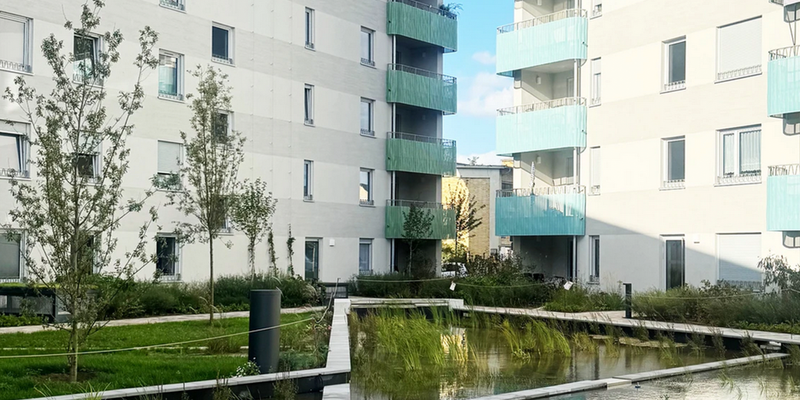
What does efficient rainwater and greywater management look like in a residential construction project? During its annual spring festival, the Association of Friends of TU Darmstadt (e.V.) honored the ReSource Mannheim pilot project with the Award for Sustainability and Interdisciplinarity. Annette Rudolph-Cleff, emergenCITY principal investigator and professor in the Department of Design and Urban Development, as well as the two emergenCITY staff members Joachim Schulze and Avikal Somvanshi, are also part of the interdisciplinary project team. In addition to the Department of Architecture and the Department of Civil and Environmental Engineering at TU Darmstadt, the University of Applied Sciences Erfurt, Darmstadt University of Applied Sciences, the Mannheim Housing Association, and an engineering firm in Koblenz also contributed to the creation of this blue-green oasis.
Innovative Watermanagement for housing complex in Mannheim
The project designed an irrigation system for a residential development that utilizes all local water sources and recycles them in a highly efficient closed-loop system. In addition to innovative rainwater management, the system is also designed to make the best possible use of greywater. This water is collected, treated, and then returned to the apartments as reusable service water. Any resulting surplus of treated water is used to provide a permanent water supply for an integrated irrigation system that serves the green spaces and mature trees surrounding the residential development. At the heart of the project is a pond system designed to resemble nature but equipped with modern technology. This serves as a temporary storage reservoir for the irrigation system but can also handle the extreme scenario of a once-in-a-century rainstorm. This also helps relieve the strain on the city’s drainage infrastructure.
Award for Sustainability and Interdisciplinarity by the Friends of TU Darmstadt
Already in 2025, the Association of Friends of TU Darmstadt recognized the work of emergenCITY researchers led by Rudoph-Cleff. The eHUB real-world laboratory—an energy-self-sufficient building where research is conducted on how to prepare the population for a prolonged, widespread power outage.
In the Sustainability and Interdisciplinarity category, the Friends of the TU awarded a total of four projects this year, with prize money totaling 10,000 euros. In addition to ReSource:Mannheim, the research projects “Prefabricated 2.0,” “Sustainable Forest Conservation – Sustainable Forest Communication,” and “HLD Element System” were selected with the support of the Office for Sustainability and the Forum for Interdisciplinary Research. In addition to actively prioritizing interdisciplinarity and sustainability, the respective concepts and their implementations had to demonstrate their scientific quality, creativity, and effectiveness.
Project ReSource:Mannheim