For several weeks now, the first data from the Heinerboxes in Darmstadt’s Martinsviertel are available on a public data platform. Residents can now check the microclimate, noise levels, and traffic volume of their neighborhood. However, such data is not only of interest to the public but also to institutions that work with environmental data.
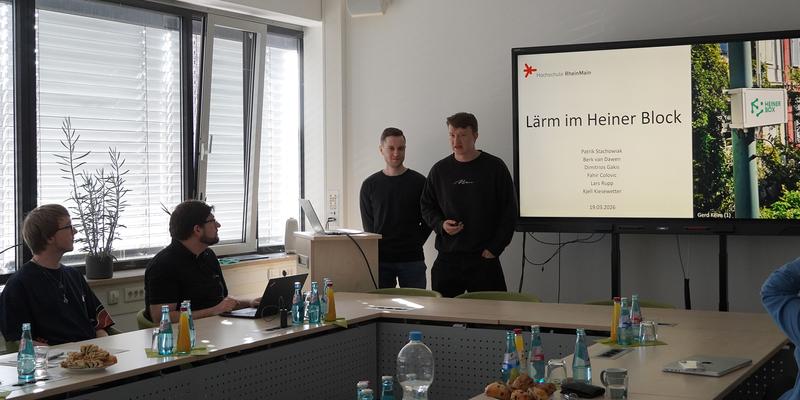
The Hessian State Office for Nature Conservation, Environment, and Geology (HLNUG) carried out a practical project in cooperation with emergenCITY at Rhein-Main University of Applied Sciences and Arts that compares the measured data from the Heinerboxes on traffic and noise in the Heinerblock with modeled data for the area. Five students in the Master’s program Bio- and Environmental Engineering, Patrik Stachowiak, Berk van Dawen, Fahir Colovic, Lars Rupp, and Kjell Kiesewetter, compared calculated noise data from the ODEN geoinformation system with live noise measurements at three sample locations of the Heinerboxes. They concluded that the calculations and measured values showed no significant deviations.
Project Presentation with the HLNUG President and Heinerbox Developers
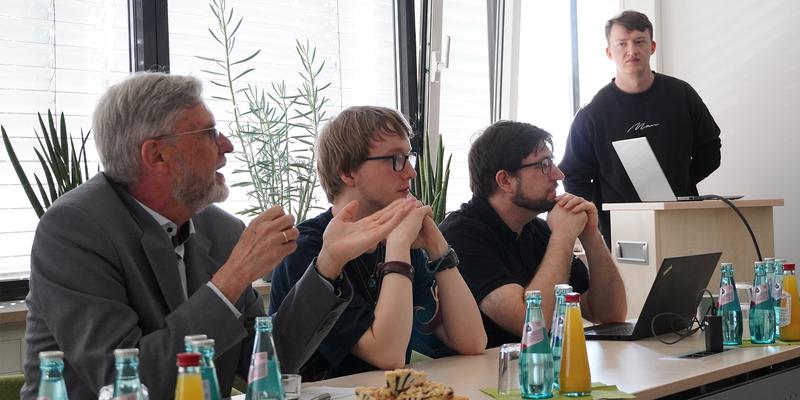
The students presented these results at the emergenCITY Lab to their instructor, Matthias Götz, Professor of Mathematics and Environmental Information Systems at Rhein-Main University of Applied Sciences and Arts, project coordinator Katja Hammer from the HLNUG, and Dr. Thomas Allinger, Head of the Department of Air Pollution and Radiation Protection, Climate Change at HLNUG, and HLNUG President and lecturer at Rhein-Main University, Prof. Dr. Thomas Schmid. Heinerbox developers Frank Hessel and Julian Euler, as well as emergenCITY Managing Director Katharina Kleinschnitger, also attended the meeting.
Following the presentation, attendees engaged in exchange about further technical questions regarding differences in data processing for the general public and the scientific community and concerning the measurement and operational functionalities of the Heinerboxes as well as data aggregation in general. Participants also laid the groundwork for continued collaboration between emergenCITY and the HLNUG, such as additional measurements from the Heinerboxes that the HLNUG could use as reference values.