
Mar
4, 2026
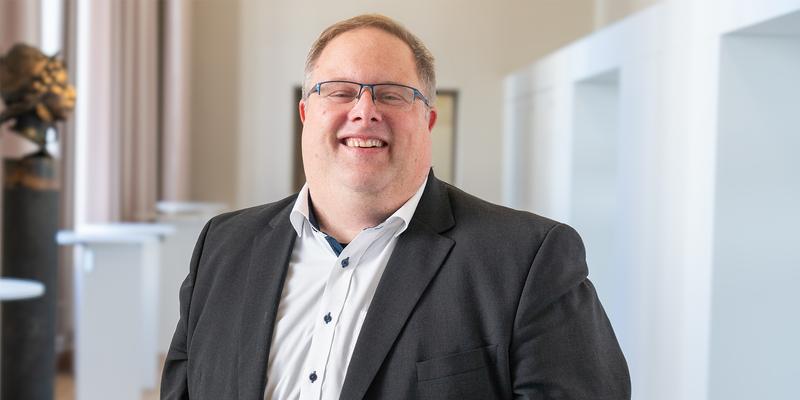
In February 2026, the group of emergenCITY Principal Investigators has welcomed a new associate member: Holger Maune, who is Professor of High-Frequency Technology in the Department of Electrical Engineering and Information Technology (etit) at TU Darmstadt since July of last year. With degrees in electrical engineering and information technology, he supports emergenCITY’s research in the areas of high-frequency components, satellite communications, and sensor systems.
High-Frequency Technology as a Technology of the Future
In his research, Maune focuses on reconfigurable and intelligent high-frequency and microwave systems. High-frequency technology is the foundation for modern communication systems such as cellular networks, Wi-Fi, and Bluetooth, as well as satellite communication systems. Radar systems in aviation or as part of autonomous driving also use high-frequency signals to identify and characterize distant objects.
“An important aspect—one that many people fail to recognize—is that high-frequency technology forms the foundation of many technologies that shape our everyday lives and thus serves as a fundamental basis for future technologies.”
A central goal of Maune’s work is the development of intelligent, adaptive, and energy-efficient high-frequency systems for future communication, radar, and sensor technologies. This includes concepts for integrated communication and sensor systems, frequency-agile transceivers, and self-optimizing front-ends that dynamically adapt to environmental conditions and operating parameters. In addition, research into the application of microwave technologies in biomedicine and scientific measurement technology constitute further focus areas.
Interdisciplinary Research Approach
Maune’s work thus covers a broad spectrum: from materials and component development, through electromagnetic modeling and circuit design, to precise high-frequency characterization and system integration. Interdisciplinarity is important to him:
“Communication—and thus high-frequency technology—is taken for granted today, much like the statement ‘electricity comes out of the outlet.’ In this context, I find dialogue with the humanities and social sciences highly interesting in order to better understand the resilience of people and society.”
A more detailed interview (in German) with professor Maune is published on the etit department website.