
Sep
11, 2026
With emergenCITY approaching the end of its final funding phase, several researchers find themselves in the intensive writing phase of their dissertations or papers. For this year’s GradDays on 27 and 28 August, the emergenCITY Graduate School, led by Michael Muma and Nadja Thiessen, therefore organised a writing sprint in cooperation with the SchreibCenter at TU Darmstadt. Over two days, the Graduate School invited doctoral researchers to put the focus on writing.
The aim: to give researchers a clear time structure and a convenient atmosphere to work on their dissertation, paper or conference contribution. Writing tutor Oliver Delto from the SchreibCenter opened the sprint on Thursday morning with a kick-off, setting fixed writing slots and introducing the different aspects of the writing process: orienting, researching, structuring, writing, and revising. With a defined writing goal for the day, all participants then turned to their documents.
Artificial Intelligence in the academic writing process
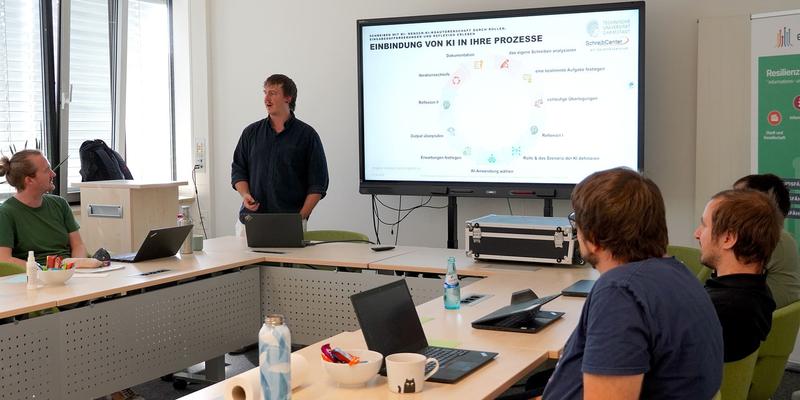
Later that morning, Tom Hölting, coordinator of the project “AI Literacy in Studium und Lehre stärken”, examined co-authorship between humans and AI. In his input (Better) Writing with AI, he encouraged participants first to analyse their own writing strategies and then, in a second step, to consider at which points in the process integrating AI might be useful. Hölting stressed that it matters not only which AI application is chosen, but also whether it is used as a conversation partner, a ghostwriter or a tutor. He also recommended setting clear expectations for AI output and then comparing and reflecting on the results. Above all, he urged the researchers to document the use of AI in academic writing in consultation with their supervising professors.
Free writing time with the option of individual consultation
During the writing slots, Hölting and Delto remained available for one-to-one consultations on individual questions about the writing process. Delto closed the day with a joint wrap-up in which participants revisited the goals they had set themselves: had they been achieved? If not, why, and what adjustments would be needed next time? On 28 August, the emergenCITY staff structured a second writing sprint together in the lab, this time without professional support from the SchreibCenter. In total, participants accumulated almost eight hours of focused writing time and made headway on pending and long-postponed writing tasks.