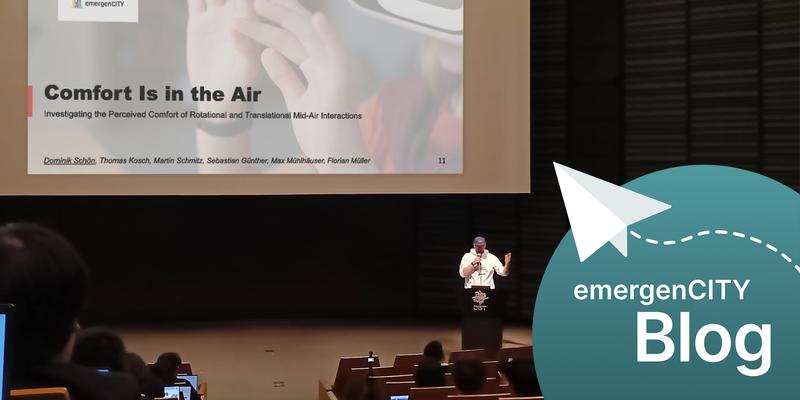
The Augmented Humans International Conference took place from March 16 to 19, 2026, at the Okinawa Institute of Science and Technology (OIST) in Japan. The conference brings together researchers annually who are working on the physical, cognitive, and perceptual augmentation of humans through digital technologies. This year, 61 papers were accepted out of 150 submissions. emergenCITY was represented with a presentation.
Ergonomic Foundations for Mid-Air Interaction
The presented work, “Comfort Is in the Air,” examines how the two fundamental gesture types in Extended Reality (XR)—translation (shifting) and rotation (turning)—affect user comfort and performance. In a user study with 20 participants, the research team demonstrates that translational movements are generally more comfortable and efficient than rotational movements. Furthermore, indirect interaction (user inputs from a distance rather than directly on the digital object) significantly increases comfort without compromising performance. Based on the results, the authors derive concrete design guidelines for more ergonomic XR applications.
Potential for Emergency Responders in Crisis Situations
XR offers enormous potential for use in crisis situations. Unlike conventional screens, XR applications can overlay digital content directly onto the real-world environment: emergency responders can see building plans, situational overviews, pollutant levels, and the spread of contaminants immediately within their field of view, without having to switch between a display and the scene of the incident. This opens up new possibilities for work in resilient cities and disaster response. However, prolonged use of mid-air gestures leads to fatigue and discomfort. This is particularly problematic in operational contexts where concentration and minimal distractions are crucial. The presented study provides, for the first time, a solid foundation for determining which types of gestures are ergonomically suitable in which spatial and task-related contexts. These findings help to design XR interfaces that are more comfortable from the ground up.
Particularly relevant here is the finding regarding indirect interaction: emergency responders often wear heavy protective gear, which makes raising their arms even more difficult. The study shows that gestures with lowered arms significantly increase comfort without compromising performance. This finding has immediate practical value for the design of XR systems in crisis management.
The study highlights that, in addition to resilient communication infrastructures, emergenCITY is also researching human-machine interfaces for crisis situations—ensuring that digital technologies are not only available but also usable in an emergency.
About the author
Dominik Schön is a researcher in the Urban Interaction Lab and the Telecooperation Lab at TU Darmstadt and associated with emergenCITY. His work focuses on the ergonomics of Extended Reality environments in the field of human computer interaction.
Publication
Dominik Schön, Thomas Kosch, Martin Schmitz, Sebastian Günther, Max Mühlhäuser, and Florian Müller. 2026. Comfort Is in the Air: Investigating the Perceived Comfort of Rotational and Translational Mid-Air Interactions. In The Augmented Humans International Conference 2026 (AHs 2026), March 16–19, 2026, Okinawa, Japan. ACM, New York, NY, USA, 13 pages.