May
20, 2026
Collaboration Award 2025
emergenCITY presents internal award for papers with outstanding collaboration between program areas



emergenCITY presents internal award for papers with outstanding collaboration between program areas
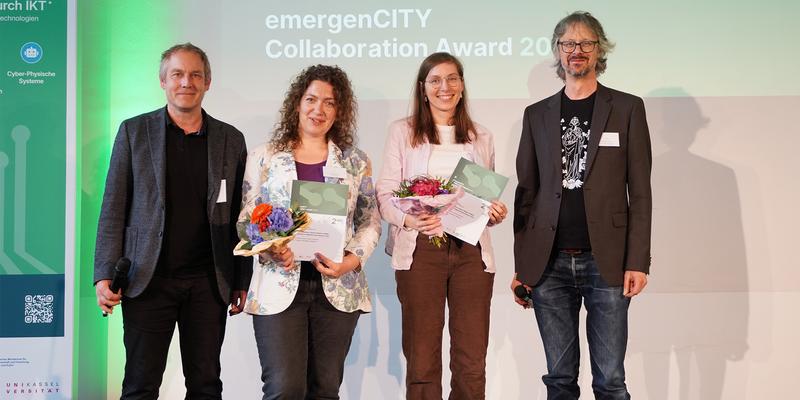
Interdisciplinary collaboration is central to emergenCITY’s works. For five years, the research center has recognized standout collaborations between scientific staff from different program areas with the emergenCITY Collaboration Award. This year, two winning papers were chosen from the publications that came out of emergenCITY in 2025. At the award ceremony during this year’s emergenCITY week, scientific coordinator Matthias Hollick and Utz Rödig, member of the emergenCITY advisory board, announced the winners.
1st place – Leon Janzen, Florentin Putz, Marc-André Kaufhold: “The User Perspective on Island-Ready 6G Communication: A Survey of Future Smartphone Usage in Crisis-Struck Areas with Local Cellular Connectivity” with Kolja Straub and Matthias Hollick
What happens to your smartphone apps when a crisis cuts off internet access and local connectivity is the only option left? The paper, that was presented at the CHI Conference of Human Factors in Computing Systems 2025 in Yokohama, Japan, introduces the concept of cellular island connectivity and presents findings from a survey among 857 adult smartphone users from major German cities regarding their smartphone usage preferences in crisis-specific use cases. Results show a shift in app demand, with users favoring general-purpose apps over dedicated crisis apps in specific scenarios. The paper prioritizes smartphone services based on their criticality, distinguishing between apps essential for crisis response and those supporting routines. Thus, it provides operators, developers, and authorities insights into user-centric design decisions for implementing island-ready 6G communication.
2nd place – Steffen Haesler, Marc-André Kaufhold, Nadja Thiessen, Michaela Leštáková: “How to Stay Connected: Citizens’ Needs on Digital Self-Organization in Neighborhoods during a Crisis” with Michèle Knodt and Christian Reuter
When the power goes out and the mobile network drops, do people find digital ways to coordinate themselves? Based on a survey with 404 affected citizens after the 2021 European floods, the paper investigates how infrastructure outages shaped digital needs and actions during the crisis. Results show that widespread disruptions in all infrastructures led many citizens to fall back to analog actions. To cope with this, the paper proposes five requirements for digital self-organization to enhance digital resilience by rethinking connectivity and understanding preparedness in a digital manner. The paper was introduced at the Mensch und Computer Conference 2025 in Chemnitz, Germany.
The Collaboration Award 2025 honored for the last time outstanding interdisciplinary research since emergenCITY will conclude its work as a LOEWE-funded research center this year.