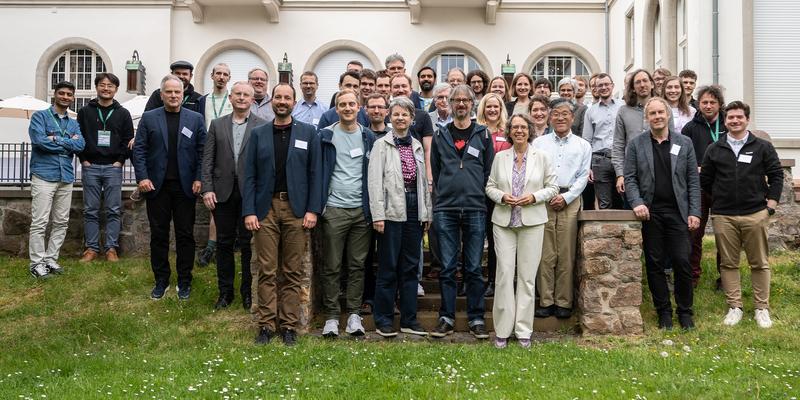
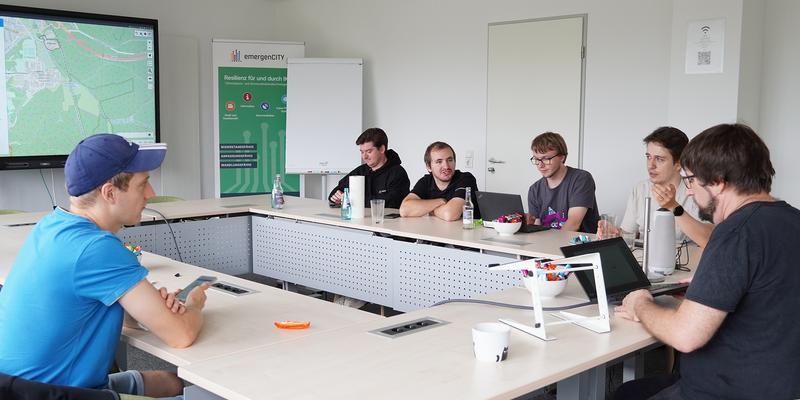
For the final time, the emergenCITY Week brought together emergenCITY researchers to engage in interdisciplinary exchange and plan future research.
As in previous years, research associates, principal investigators (PIs), and the emergenCITY Scientific Advisory Board gathered also 2026 for two days at the Georg-Christoph-Lichtenberg-Haus to share the latest research developments and foster collaboration across disciplines. This year, the approaching end of LOEWE funding for emergenCITY in December 2026 prompted the program to include several retrospectives and open up a discussion on the future of research into the resilience of digital cities.
Consolidating existing research on critical infrastructure and resilience through an interdisciplinary approach
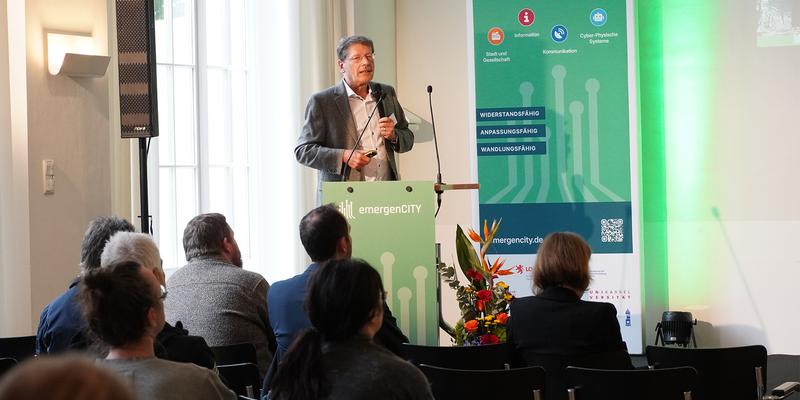
During the opening of the event, Ralf Steinmetz, former principal investigator and now Distinguished Emeritus at emergenCITY, looked back to the start of emergenCITY. He noted that the idea of building resilient, reliable, and adaptable systems was not new when emergenCITY was founded. For more than 20 years, its research topics had been addressed in various predecessor projects. However, in pursuing the establishment of the LOEWE Center emergenCITY, Steinmetz, together with other emergenCITY PIs, aimed to bring together dedicated individuals to conduct research on resilient digital cities in an atmosphere of commitment and enjoyment.
“Never give up. The topic is more important today than ever,” the now-emeritus professor Ralf Steinmetz urged the audience by the of his speech.
Utz Rödig, Professor of Computer Science at University College Cork and a member of the emergenCITY Scientific Advisory Board, also emphasized:
“The research on what we now call critical infrastructure is not new. The public perception changed quite a bit in the past few years since the start of emergenCITY. Everyone understands the need of it.”
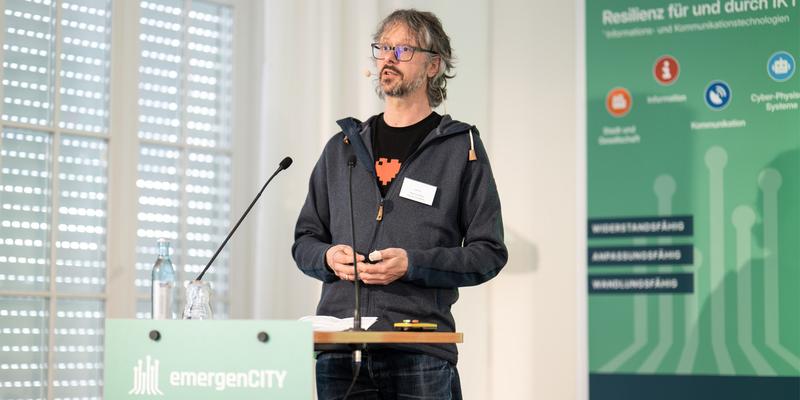
Ralf Steinmetz during his talk
Towards international recognition and practical impact
Rödig emphazised that emergenCITY has gained international visibility through its research contributions, which emerge from a unique combination of research topics spanning various disciplines. He pointed out that the research center’s infrastructure has made it possible to produce not only testbeds and papers but also practical demonstrators in real-world application such as the Heinerbox and Krisopolis. From scientists who began their work via Zoom in the midst of the COVID-19 pandemic, a research community has grown that achieves societal impact and is recognized for its pioneering role on the resilience of digital cities, concluded Rödig.
Satoshi Tadokoro also reiterated the international significance and application-oriented research in the field of first response in crisis situations that emergenCITY has achieved in recent years. He is an associate professor at the Tough Cyberphysical AI Research Center at Tohoku University in Japan and also a member of emergenCITY’s scientific advisory board.
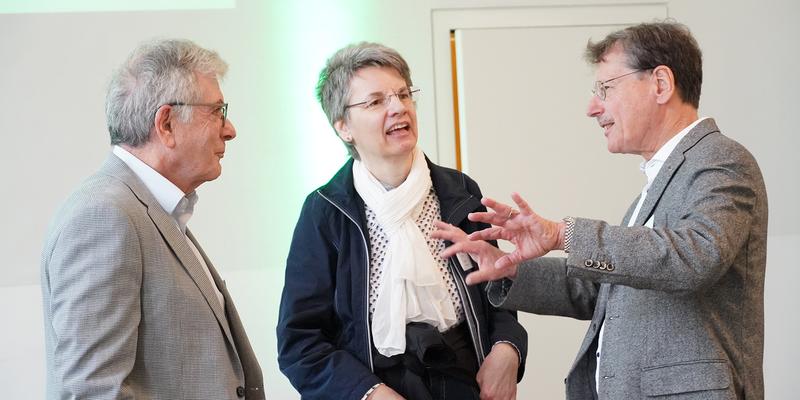
emergenCITY Advisory Board Member Hans Heinimann (left) in conversation with Anja Klein and Ralf Steinmetz
From sensor technology to satellite communication and ad-hoc data management
During the course of the event, emergenCITY staff members presented selected research projects for each of the center’s four program areas.
From the Information program area, Markus Henkel presented how smart home technologies can complement existing warning systems in the event of a crisis. Marcian Seeger discussed work on ad-hoc data management in crisis situations from Thorsten Papenbrock’s Big Data Analytics group at Philipps University of Marburg. Zsolt István, professor in the Systems Group at TU Darmstadt, introduced approaches to making systems more resilient using Field-Programmable Gate Arrays (FPGA) in Edge Computing.
From the Communication program area, emergenCITY alumnus Julian Zobel talked about the idea of using Delay Tolerant Networks (DTN) in satellite communications. Christian Eckrich presented resilience approaches for and through distributed sensing, particularly in the field of radar sensors. Frank Hessel revisited the development of the Heinerbox, a sensor box for environmental data and emergency communication testing, which emergenCITY has installed last year in Darmstadt’s Lichtenbergblock.
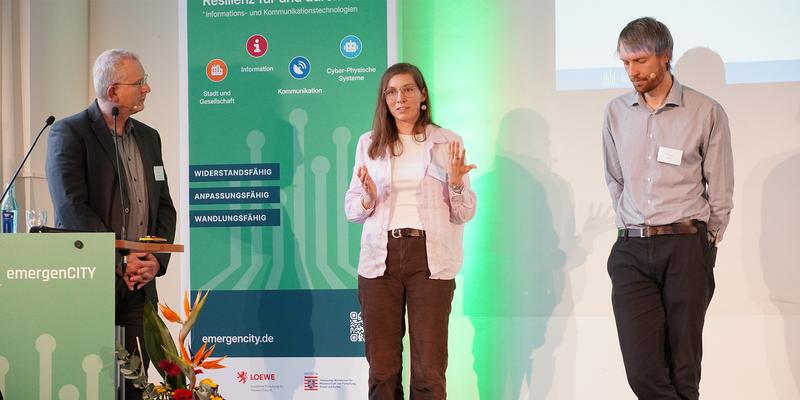
Michaela Leštáková (middle) and Kevin Logan (right) during their presentation with Oskar von Stryk, coordinator of the program area CPS
Serious games, flood risk management, and open-source rescue robots
Nadja Thiessen summarized a similarly tangible research result for the City and Society program area: the publicly released mobile serious game Krisopolis. emergenCITY alumnus Lucas Flath presented a case study on the coordination of various actors in flood risk management using the city of Mörfelden-Walldorf as an example, and Avikal Somvanshi introduced his research, which examines living conditions for vulnerable groups during a heat wave combined with a power outage.
For the Cyber-Physical Systems program area, Michaela Leštáková and Kevin Logan presented their research on resilient water distribution systems. Christoph Löser and Stefan Fabian introduced four approaches to rescue robotics that can help locating victims in complex, multi-story environments during disasters: a radar system capable of detecting vital signs through walls, a multi-story elevation map, and the open-hardware rescue robot Athena and its flippers, which it uses to autonomously navigate around obstacles.
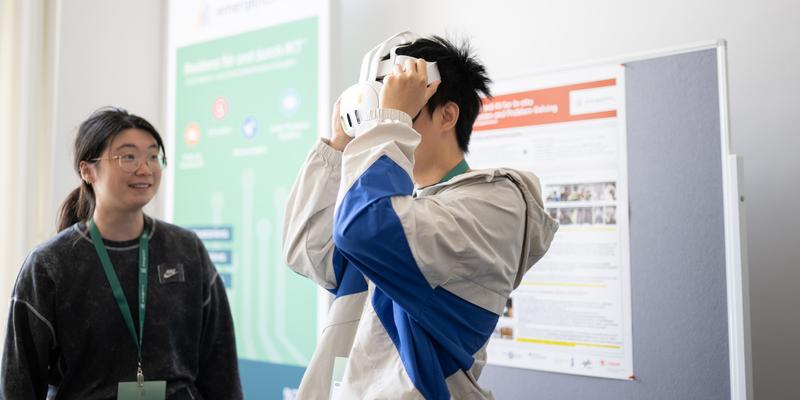
Yanni Mei (left) presenting her demonstrator ShadAR during the poster session.
In-depth discussions, a new mission, and hands-on demonstrators
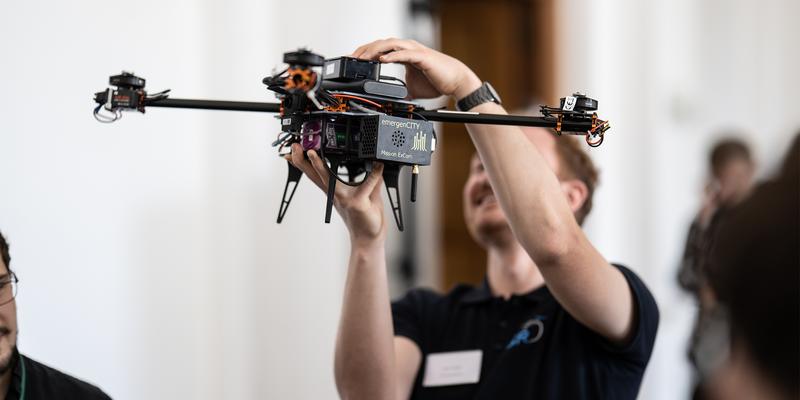
A poster session provided further insights and opportunities for in-depth discussions. In addition to numerous posters, Yanni Mei presented ShadAR, an application that allows users to create on-demand augmented reality images by verbally describing how they want to see the world. In addition, the new Extreme Communication mission introduced itself for the first time. Researchers here are working to establish communication even under extreme conditions using drones and various network connections, in order to respond quickly and efficiently to a crisis.
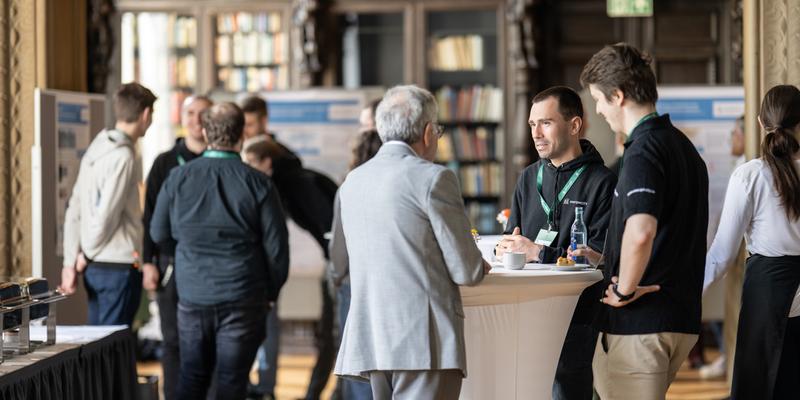
Austausch und Gespräche während der Poster Session
Team success for research on the resilience of digital cities
Greetings and presentations during emergenCITY Week also addressed the approaching end of emergenCITY’s funding period in December. Heribert Warzecha, Vice President for Academic Affairs at TU Darmstadt, highlighted the center’s interdisciplinary approach and the translation of research ideas into practice through dialogue with the public.
“emergenCITY is an absolute success story,” summarized the TU Vice President.
From an internal perspective, emergenCITY Coordinator Matthias Hollick looked back on more than 35,000 emails containing the keyword emergenCITY until today. He thanked all the researchers, the Executive Board and the administrative office, as well as the participating universities, the funding officials at the Hessian Ministry of Science and Research, Art and Culture, and the scientific advisory board of emergenCITY for their work, dedication and support. emergenCITY has not only produced award-winning scientific results but also an impact that can help make this world a better place, he resumed.
“This project really brought me joy. I firmly believe science is a team achievement,” Hollick concluded.
Matthias Hollick during the emergenCITY Week
The end of highly interdisciplinary research in one center
Max Mühlhäuser, former Principal Investigator and now Distinguished Emeritus at emergenCITY, stated clearly that the end of emergenCITY marks the loss of a unique research hub.
“With emergenCITY, the world’s only highly interdisciplinary center on digital resilience is coming to an end,” Mühlhäuser critizied.
After December, various aspects of emergenCITY’s research will continue elsewhere, as Hollick and emergenCITY board member Michèle Knodt emphasized. A follow-up project, the Digital Resilience Xchange (DiReX) Application and Transfer Center, has already been launched to accelerate the transfer of emergenCITY research findings into real-world application. emergenCITY Principal Investigator Björn Scheuermann also presented plans for a new focus on resilience through satellites and resilience in space. Further proposals and projects are in the planning and application stages. The emergenCITY Lab will continue to operate within the TU Darmstadt and will relocate to the TU campus in the city center eventually.