

Jul
7, 2026
Blog
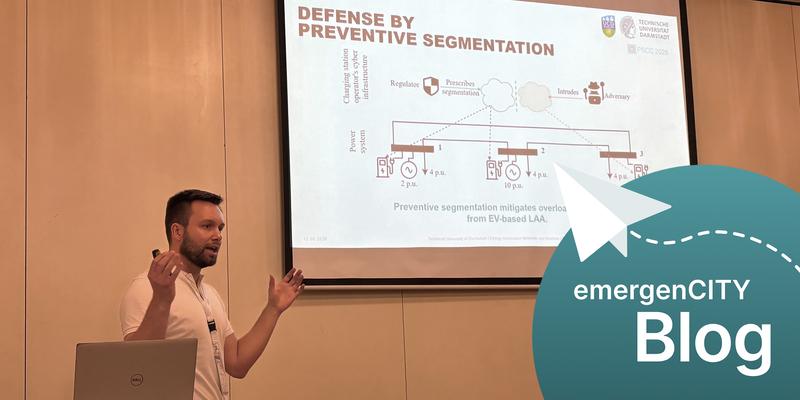
From June 8 to 12, 2026, a journey took me to Limassol, Cyprus, for the 24th Power Systems Computation Conference (PSCC). PSCC is one of the leading international conferences on the analysis and computation of electric power systems, bringing together researchers at the intersection of power engineering, optimization, and computer science.
At the conference, I gave a talk on our paper “Defending the Power Grid by Segmenting the EV Charging Cyber Infrastructure”, which I co-authored with emergenCITY PI Florian Steinke and Efthymios Karangelos. The work addresses a simple question: What happens if an attacker gains control of electric vehicle charging stations and uses them to manipulate power demand? With an installed public charging capacity of around 8.3 GW in Germany (as of April 2026), this is no longer a niche issue. Charging station operators communicate with their stations via a shared cyber infrastructure. If this infrastructure is compromised, an attacker can switch many chargers on or off simultaneously, overloading transmission lines and transformers.
Minimize the attack surface by segmenting the infrastructure
Using a reconstructed model of the German transmission grid and real public charging data, we show that hacking just two operators can already lead to overloaded lines. As a countermeasure, we propose preventively segmenting the cyber infrastructure so that a single attack can no longer access enough charging capacity to cause damage. Such segmentation is also in line with the NIS2 Directive, the binding EU directive on network and information security. Its implementation guidelines, developed by the European Union Agency for Cybersecurity (ENISA), list network segmentation as one of the recommended cybersecurity measures for critical entities. We formulate this as an optimization problem and propose rule-based segmentation strategies that come close to the optimal solution and could serve as a basis for future regulatory measures.
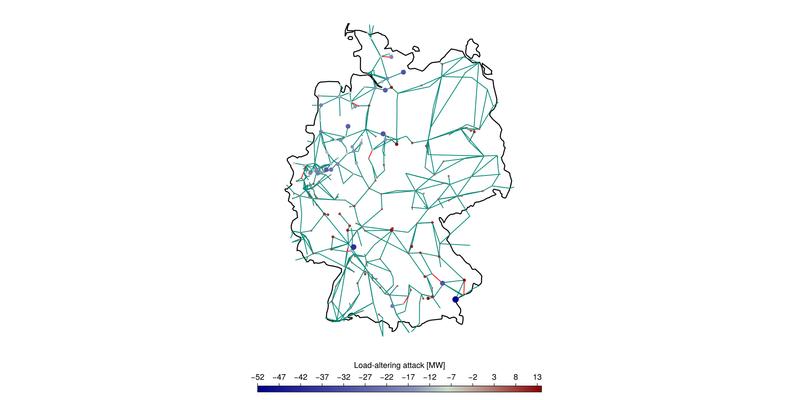
map of Germany showing the load-altering attack across the transmission grid (Figure from the paper).
With this analysis of the resilience of electric vehicle charging stations, we examine how well a specific critical infrastructure can withstand coordinated cyberattacks. The power grid is the backbone of every digital city. Understanding how technologies such as EV charging infrastructure can become an attack surface is essential to keeping cities functional in a crisis.
Detailed feedback and open discussions
The journey was highly valuable for my future work. I received detailed feedback on the modeling and made contact with several groups working on cyber-physical security in energy systems, paving the way for future collaborations. The data underlying the study is freely available in the accompanying repository.
What I take away is a strong sense of how active and international this research community is. I especially enjoyed the open discussions after the talks, where questions often turned into concrete ideas. I would like to thank emergenCITY for supporting this journey.
About the author
Kirill Kuroptev is a research associate and doctoral candidate at the Energy Information Networks & Systems Lab (EINS) in the Department of Electrical Engineering and Information Technology at the Technical University of Darmstadt. His research focuses on optimization-based defense strategies against cyber-physical attacks and stress-testing frameworks for the power grid. He is an associated researcher at emergenCITY.