Resilient Technology on Streetlights: Heinerboxes Make Darmstadt Crisis-Proof
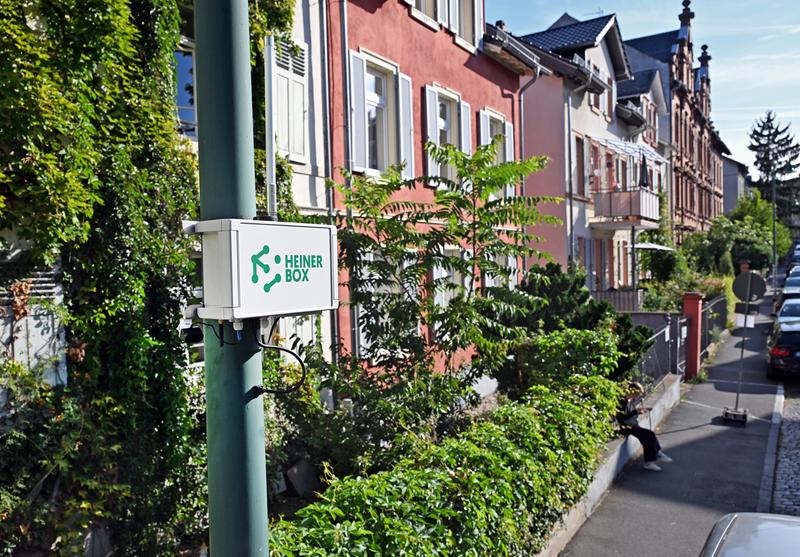
A team from TU Darmstadt is currently working with the so-called “Wissenschaftstadt” Darmstadt to install Heinerboxes developed at the LOEWE Center emergenCITY: sensor boxes that can also set up an emergency network. They not only collect environmental data and traffic information, but also test new ways of crisis communication. This is transforming Darmstadt’s Lichtenbergblock into a real-world laboratory for emergency communication and sustainable urban development.
In late November, the first Heinerboxes were installed in Lichtenbergblock, a ten-hectare section of Darmstadt’s Martinsviertel neighborhood. A total of around 40 boxes will be mounted on streetlights, where they will measure the microclimate and traffic in the neighborhood at a height of approximately four meters. The team at the LOEWE Center emergenCITY developed the Heinerbox in and for Darmstadt. Hence, the name: “Heiner”, the nickname for Darmstadt residents, meets sensor boxes. What distinguishes the Heinerbox is that its sensors measure in everyday life as well as under difficult conditions, and it has the necessary technology to set up an emergency network in case of an emergency. The Digital Resilience Xchange (DiReX) application and transfer center, which also belongs to TU Darmstadt, is supporting the further development of the boxes in practical operation, among other things.
Hesse’s Minister of Science Timon Gremmels explains:
“With the Heinerboxes, Darmstadt is demonstrating how excellent research can be directly applied to people’s everyday lives. What scientists at the LOEWE Center emergenCITY have developed is being put into practice here in the Lichtenbergblock: state-of-the-art measurement technology helps to better understand the neighborhood and it can save lives in case of an emergency. The measurement data from the Heinerbox will be publicly available and explained in an understandable way on a website. This greatly increases trust in science. The connection between science, the city, and civil society makes the neighborhood a real-world laboratory for sustainable urban development and resilient crisis communication—and thus a model far beyond Hesse.”
emergenCITY coordinator Matthias Hollick and Heinerbox developer Frank Hessel discuss the development of the Heinerbox.
Hanno Benz, mayor of the science city of Darmstadt, emphasizes:
“For Darmstadt, the close connection to research at TU Darmstadt is a stroke of luck. Here in the neighborhood, we can test which technologies will help with the urban planning of tomorrow and in times of crisis without additional costs for the city.”
In addition to the Heinerbox, the real-world laboratory in the Lichtenbergblock also includes Litfaßsäule 4.0, a prototype warning column on Riegerplatz that has been in place since April. The energy-self-sufficient column can still display information and warning messages even during a power outage.
Resilience and benefits in the event of a crisis considered from the very outset
The sensor boxes are designed to function even in crisis situations. If power, internet, or mobile phone service is down for several days, the boxes continue to collect data thanks to the integration of a battery and various wireless technologies such as LoRa, WiFi, and Bluetooth. The Heinerboxes are particularly valuable in a crisis: their data can provide emergency services with crucial information. For example, higher levels of particulate matter can indicate a fire, and traffic data supports the planning of aid and rescue measures. DiReX will continue to pursue such practical applications in the coming years.
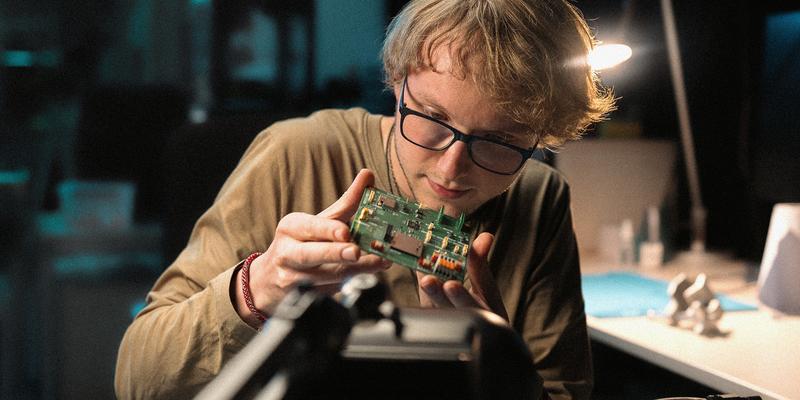
The researchers at emergenCITY developed a specific circuit board for the Heinerbox.
“In times of crisis, we need reliable digital technology to respond to critical events in the best possible way and recover quickly from the crisis. With DiReX, we are investing specifically in the future viability of our country and strengthening our digital resilience, both scientifically and practically,” affirms Prof. Dr. Kristina Sinemus, Hessian Minister for Digitalization and Innovation, in Wiesbaden.
“Resilience does not arise in the laboratory, but in cooperation,” adds Michèle Knodt, Director of DiReX and Professor of Political Science at TU Darmstadt. “When people understand, have a say, and help shape things, digital technology becomes a real strength in the event of crises. That is exactly what we want to achieve with DiReX and the Heinerbox – together with the city, politicians, and citizens.”
In the future, researchers also want to use the Heinerboxes to test new communication methods for crisis situations.
An emergency network for the population in the Lichtenbergblock
The built-in radio technologies could also enable an emergency network in the event of an emergency in the future. This could be used to disseminate warnings and instructions from the authorities or to send out calls for help. The initial idea is to connect to a Heinerbox via Wi-Fi if there is no other network available and get a simple website displayed with up-to-date information on the situation on your own cell phone.
In order to involve everyone in the neighborhood, the Heinerboxes are accompanied by a broad-based information campaign. This includes a website, information in the neighborhood, and a film featuring prominent Darmstadt personalities such as actor Hans-Joachim Heist, city guide Aurora DeMeehl, and YouTuber Dietmar Diamant. The researchers are also committed to transparency: the measurement data and research results will be made publicly available so that everyone can see what is changing in the neighborhood. In the coming weeks, each street lamp with a Heinerbox will be given a QR code that can be used to access the data.
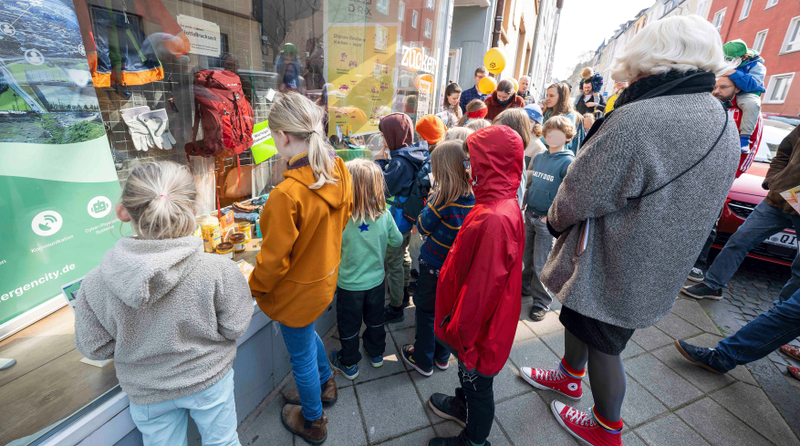
Another event is planned for next spring to get people talking about resilience together and locally. DiReX and emergenCITY are inviting everyone to a family rally in the Lichtenbergblock. The focus will be on the Heinerboxes and the topic of crisis preparedness – presented in a playful, exciting, and child-friendly way. The rally will kick off on March 21, 2026, with a big action day where families and interested parties can puzzle, discover, and try things out at various stations in the neighborhood.