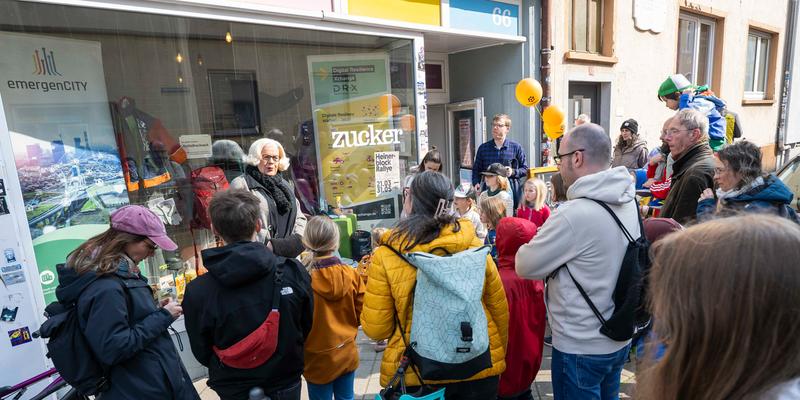
What’s supposed to be packed in an emergency backpack? What can cities do to better protect us from heavy rain falls? How does the Heinerbox work-and how can the Litfaßsäule 4.0 help in a crisis? Families who took part in the Heinerblock Rally over the weekend were able to answer these and other questions about crisis preparedness by the end of the event.
“We’re delighted that the rally, which aims to convey knowledge and research on digital resilience in a playful way, was so well received on the very first day,” said Michèle Knodt, deputy coordinator of emergenCITY and DiReX director at TU Darmstadt. “After all, crises like power outages or heavy rain are on the rise. Those who are prepared can react faster in an emergency.”
A tour through Darmstadt’s Lichtenbergblock with Aurora DeMeehl
The guided rally tour with Darmstadt showgirl and city guide Aurora DeMeehl, who led children and adults through the Lichtenberg Block with wit and charm, was very well received. The search for locations of the rally’s stops based on small image snippets was particularly popular with the younger participants, while the older children eagerly answered the puzzle questions in the rally booklet.
At four stops, the event also featured small interactive activities developed by students from TU Darmstadt: Children made calls using a paper cup telephone, they built a tower of water bottles, and answered a survey about safe routes to school. As a reward for successfully solving the puzzles, small surprises awaited the participants at Riegerplatz, along with personalized keychains printed on a 3D printer.
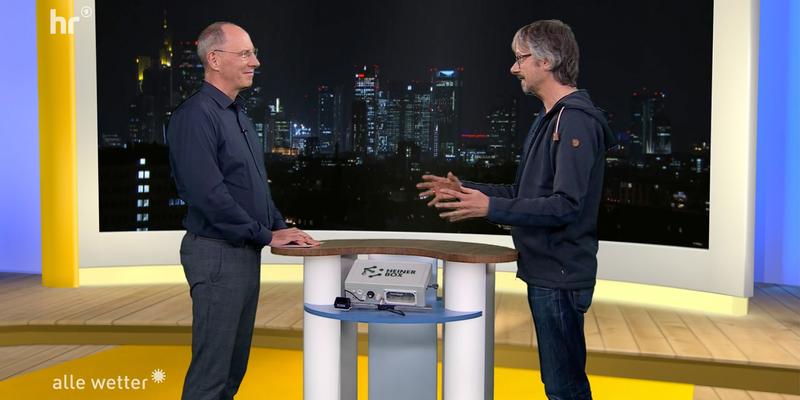
The children also thoroughly tested out the creative roller slide and the small vehicles from the playmobile, while the adults had Frank Hessel, a research assistant and developer of the Heinerboxes, explain the Heinerboxes in detail once again or stopped by the ADFC booth.
Background on the Heinerblock Rally
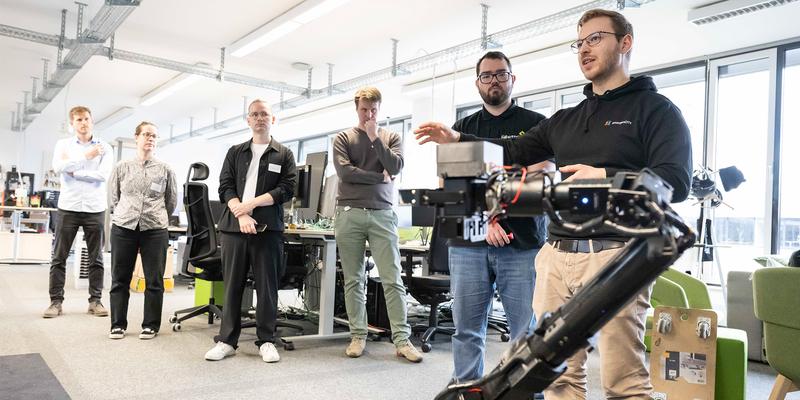
Since last year, researchers of emergenCITY and DiReX have been collaborating with the City of Darmstadt to conduct on-site research in the Lichtenbergblock on resilient crisis communication and the development of the neighborhood using sensor data. At the heart of this work are two demonstrators developed in emergenCITY: The Litfaßsäule 4.0 on Riegerplatz can display information and warnings on a screen, and 40 Heinerboxes measure and publish anonymous environmental and traffic data. In the future, researchers will work on how the Heinerboxes can be used to establish an emergency network in the event of power, internet, or mobile network outages.
But those rather technical ideas are only one component of the research in the neighborhood. It also requires the neighborhood’s understanding of how these ideas work and on-site dialogue to be better prepared for crises.
“This social resilience is also an important building block of our research,” explained Matthias Hollick, scientific coordinator of the LOEWE Center emergenCITY and professor of Secure Mobile Networks. “A rally as a discovery tour through the neighborhood—which becomes a research site within the city—offers us an important opportunity to reach and inform local residents about our topics.”
Explore the Heinerblock Rally on your own until May 31
Until May 31, families have the opportunity to discover the Heinerblock Rally on their own. All they need is a pen and the free rally booklet, which they can pick up at various distribution points in the Lichtenbergblock, including Pizzeria Mono, Café 3klang, and the Lesezeichen bookstore.
The Heinerblock Rally is designed for families with children between the ages of six and twelve, but is open to all age groups. It covers just under two kilometers, taking participants to ten stops, and lasts about an hour. It was developed by emergenCITY and DiReX in collaboration with the Darmstadt-based agencies quäntchen+glück and merkmal.
Heinerblock Rally: www.emergencity.de/s/rallye
Heinerbox: www.heinerbox.tu-darmstadt.de