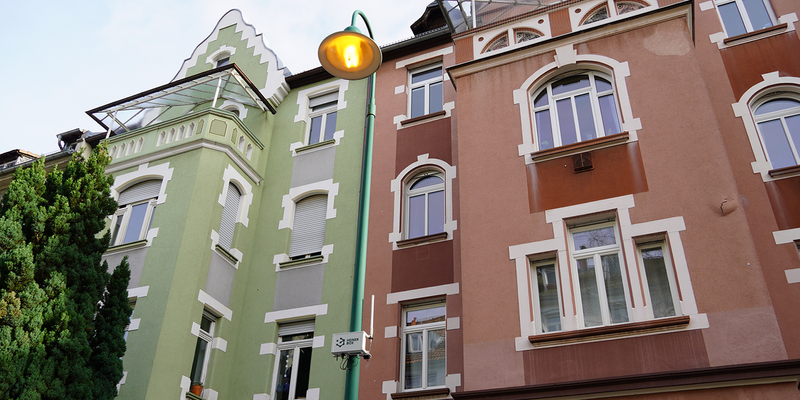
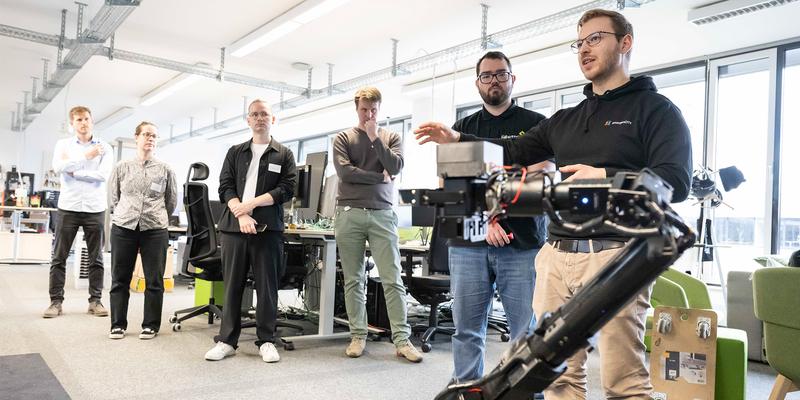
The official press release and the launch of a comprehensive information campaign on the Heinerboxes, which were installed in Darmstadt’s Lichtenbergblock district in recent weeks, triggered nationwide media coverage. Hessischer Rundfunk, FAZ, and Darmstädter Echo reported in various formats on the sensor boxes, which will collect environmental data in the future while also providing the infrastructure to test new communication channels for crisis situations.
Hessischer Rundfunk produced several reports for hessenschau on December 17, 2025, and reported on it in an online article that was picked up by tagesschau.de. They accompanied the installation of the sensor boxes in the Lichtenbergblock and interviewed emergenCITY coordinator Matthias Hollick. The core topic remained the question of exactly what data is collected by the Heinerbox and how it is handled.
Paul Georg Wandrey, Head of Transportation for the City of Darmstadt, also commented on the traffic measures that emergenCITY is scientifically monitoring using data from the Heinerbox: “Even the effects of minor changes” can be evaluated using the data.
The Frankfurter Allgemeine Zeitung and the Darmstädter Echo presented the Heinerbox primarily in terms of how it works. In addition to the report on December 16, 2025, Echo editor Frank Schuster wrote a commentary entitled “Heinerboxen überwachen nicht” (Heinerboxes do not monitor) on the issue of data protection in Heinerboxes.
“Here, without collecting personal data, practical research is being conducted into how cities and people, who are becoming increasingly dependent on power grids and internet connections, can remain resilient even in the event of a collapse due to disasters or wars,” he concludes.
In its print edition dated January 3rd, 2026, as well as online, the Frankfurter Allgemeine Zeitung emphasized the concrete benefits of the Heinerboxes in the event of a crisis: Higher particulate matter levels could potentially indicate a fire, and in the future, an emergency network is to be tested that will allow residents to receive information even without electricity, internet, or mobile phone coverage. To this end, the sensor boxes are equipped with various data transmission standards, including LoRaWAN (Long Range Wide Area Network), Wi-Fi, and Bluetooth.