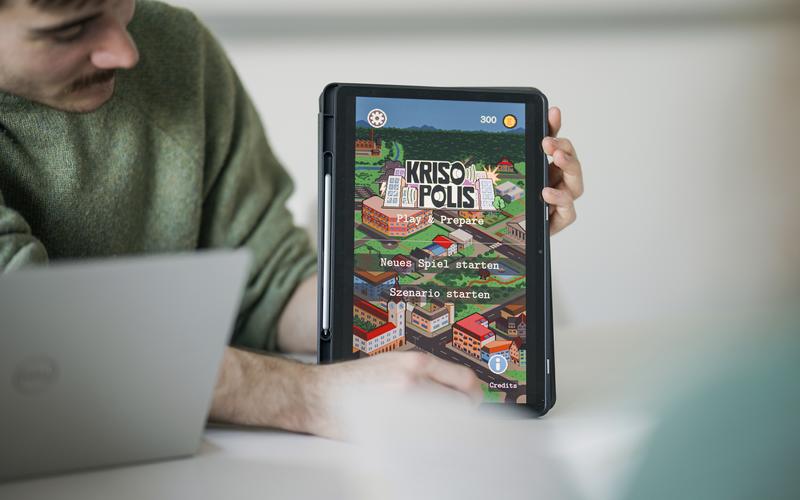
With its retro pixel art style, Krisopolis depicts the fictional world of a city of the same name, which is regularly affected by various crises. Whether it’s contaminated drinking water, prolonged power outages, or lockdowns – the residents of Krisopolis are familiar with such scenarios and are preparing for them.
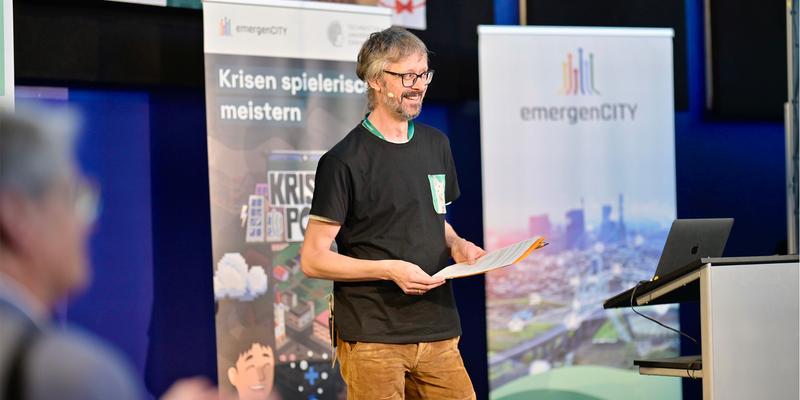
“Besides being fun and full of lovingly crafted details, Krisopolis pursues another goal,” explained Matthias Hollick, emergenCITY coordinator and professor of secure mobile networks at TU Darmstadt. “As a serious game, it imparts knowledge about crisis preparedness, helps players be able to act effectively in emergencies, and promotes collaborative action in crisis management. We explore these serious topics in a playful way, and the fun of the game enhances the learning effect.”
Players, too, must prepare for the changing crisis scenarios in their everyday lives within the game and weigh up various decisions: Are there enough supplies in their inventory? What is the state of their avatar’s health? Who in the neighborhood needs support?
Tips and advice from the Federal Office for Civil Protection and Disaster Relief (BBK) are integrated
eCoins are awarded for proactive actions, which can then be invested in supplies and equipment. The interests of the community play a major role alongside the avatar’s own needs. Tips and advice on crisis preparedness are directly integrated from information provided by the Federal Office for Civil Protection and Disaster Relief (BBK).
“Krisopolis clearly demonstrates how knowledge transfer from research to society can work. I am particularly pleased that the development of the game involved not only researchers from the interdisciplinary LOEWE Center emergenCITY, but also students. emergenCITY conducts excellent research on innovative solutions for digital resilience – something we as the Hessian state government are proud of,” said Christoph Degen, State Secretary at the Ministry of Science and Research, the Arts and Culture.
“Having fun while learning something important. This sounds very sensible. A playful approach helps not only children to remember things more easily and reduce anxieties,” said Hessians Minister for Digitalisation and Innovation Prof. Dr. Kristina Sinemus in Wiesbaden.
From a Student Project to a Fully-Fledged App
Five students at TU Darmstadt conceived the basic idea for Krisopolis during a computer science internship in the winter semester of 2023. An interdisciplinary team from LOEWE emergenCITY – Joachim Schulze, Nadja Thiessen, and Julius von Willich – provided intensive support for the project. One of these students, Jakob Huth, a Cognitive Science student at TU Darmstadt, developed the app to market readiness. After initial presentations, trials, and game tests, the app has now been released by emergenCITY through TU Darmstadt.
“With Krisopolis, the research from emergenCITY has successfully completed the long road to market readiness. And it proves that science doesn’t happen in a vacuum, but serves people and society,” said Prof. Dr. Thomas Walther, Vice President for Innovation and International Affairs at TU Darmstadt.
However, the game’s development is not yet complete with the release.
“The Digital Resilience Xchange (DiReX) Application and Transfer Center will further develop the game and also intensify cooperation opportunities with schools. The goal is to make the serious game more accessible, especially to children and families,” said Michèle Knodt, Director of DiReX and Professor of Political Science at TU Darmstadt.
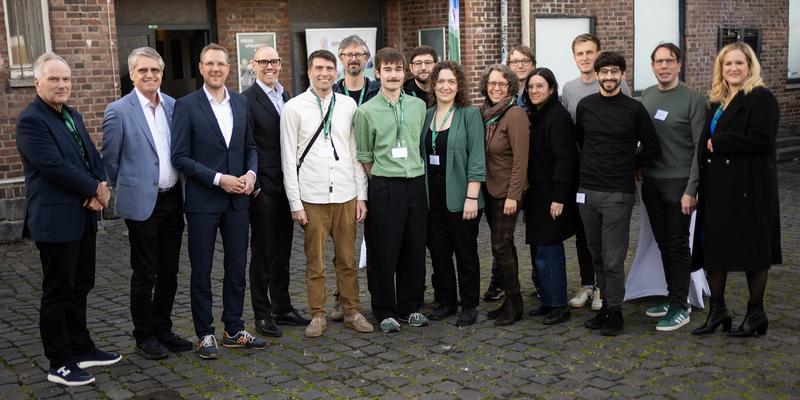
The opening ceremony provided insights into other research projects
Following the presentation of Krisopolis, developer Frank Hessel also introduced the Heinerboxes: sensor boxes that have been installed in Darmstadt’s Lichtenbergblock since the end of November to measure environmental data and test new communication methods in the future. The film clips featuring actor Hans-Joachim Heist and Darmstadt personalities Aurora DeMeehl and Dietmar Diamant, which were produced as part of a comprehensive public information campaign, were also shown.
At various gaming stations, guests were also able to exclusively test Krisopolis and the second serious game, “eHUB cities – Blackout,” which is currently being developed by emergenCITY and will also be available to play for free in May of next year. This more story-driven computer game weaves exciting narratives across two levels in a world where so-called eHUBs – energy-autonomous houses that function as energy suppliers and information hubs in their neighborhoods – are already part of everyday urban life. The game thus expands upon possibilities that are being prototypically explored in emergenCITY’s eHUB real-world laboratory on the TU Campus Lichtwiese.
The app is now available for free download for mobile devices via the Apple App Store and soon in the Google Play Store as well.
Download Krisopolis in the Apple App Store
Download Krisopolis in the Google Play Store
Website of the Serious Game Krisopolis
About the emergenCITY mission “Serious Games”
To the Krisopolis demonstrator at DiReX