Innovative Solutions for Crisis-Resilient Structures
Digital Minister Prof. Dr. Kristina Sinemus and Minister of State for Federal-State Cooperation Dr. Michael Meister Visit the emergenCITY-Lab in Darmstadt
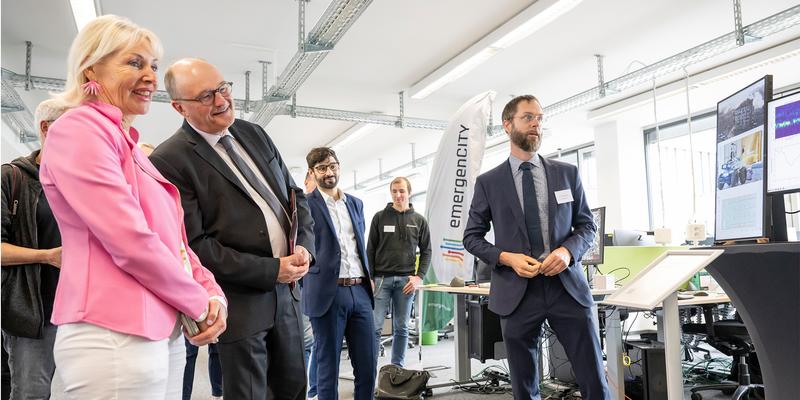
Hesse is consistently pursuing the development of innovative solutions for digital resilience and crisis-proof infrastructure, thereby playing a pioneering role nationwide. At the emergenCITY-Lab in Darmstadt, Digital Minister Prof. Dr. Kristina Sinemus and Dr. Michael Meister, Minister of State for Federal-State Cooperation at the Federal Chancellery, learned about current research projects and demonstrators that show how digital systems can function reliably even in exceptional situations.
With the Digital Resilience Xchange (DiReX) Application and Transfer Center at the Technical University of Darmstadt, a central component was established in 2025 to make digital infrastructures more resilient. DiReX’s goal is not only to make scientific findings visible but also to put them directly into practice through real-world laboratories, demonstrators, startup support, and continuing education programs. The center builds on the research results of the LOEWE Center emergenCITY. There, instruments such as the “Litfaßsäule 4.0” and the “Heinerboxen” were developed to help provide information for citizen in crisis situations when other means of communication have failed.
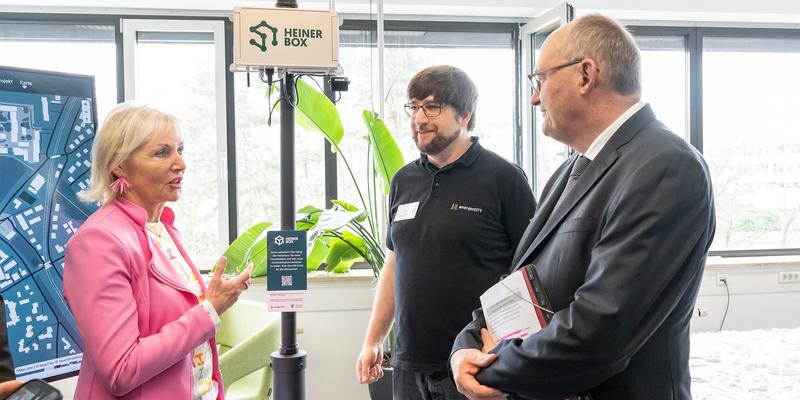
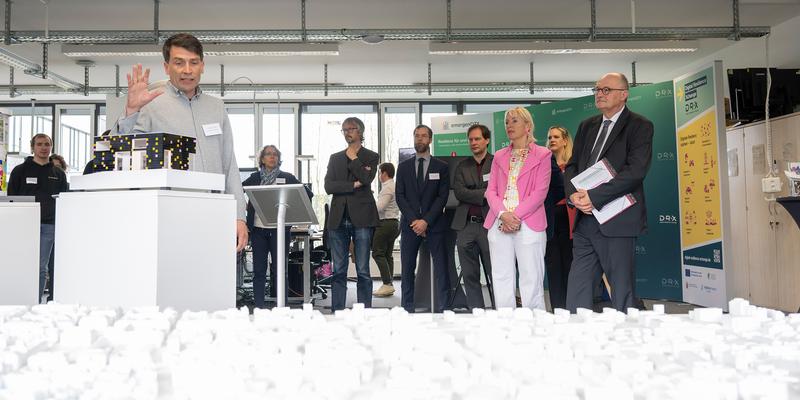
Heinerbox developer Frank Hessel answered questions from Digital Minister Prof. Dr. Sinemus and Minister of State for Federal-State Cooperation Dr. Michael Meister
Sustaining research, transferring results into practice
“The visit to the emergenCITY Lab impressively demonstrates how excellent research leads to concrete solutions that can save lives in an emergency and ensure the functionality of critical infrastructure. This close interdisciplinary collaboration provides important impetus for the future viability and resilience of digital systems in Hesse and beyond. Our goal is to quickly translate research findings into practical applications—for robust networks, reliable communication, and functional infrastructure in the event of a crisis,” said Digital Minister Prof. Dr. Kristina Sinemus.
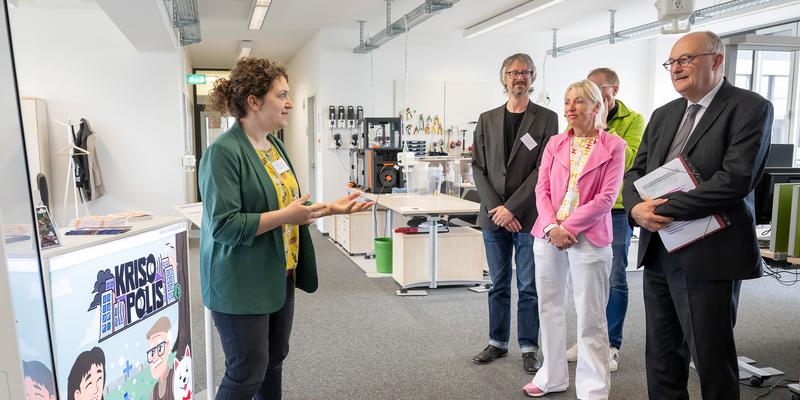
emergenCITY researcher Dr. Nadja Thiessen presented the serious game Krisopolis
Dr. Michael Meister, Minister of State for Federal-State Cooperation at the Federal Chancellery, emphasized:
“The LOEWE emergenCITY Center demonstrates how interdisciplinary cooperation among various stakeholders can successfully develop practical solutions to protect cities’ digital infrastructures. The collaboration between several Hessian universities, the Federal Office for Civil Protection and Disaster Assistance, the City of Darmstadt, and the German Aerospace Center serves as a model.”
Vincenz Mechler, research associate at the Secure Mobile Networks research group at TU Darmstadt, presented a current research project on networked situational awareness using the example of a major fire at emergenCITY
“At the LOEWE Center emergenCITY, we have been able to conduct research into key foundational areas in recent years and, building on that, develop concrete solutions for digital resilience in the event of disasters,”
summed up Prof. Dr. Matthias Hollick, head of the Secure Mobile Networks research group at TU Darmstadt and scientific coordinator of the LOEWE Center emergenCITY, which has been conducting research on resilient digital city infrastructures since 2020.
“Today, crises and disasters are increasingly part of everyday life. We want to pursue a long-term strategy to continuously apply the results of our research and thereby empower society as a whole to better cope with disasters.”
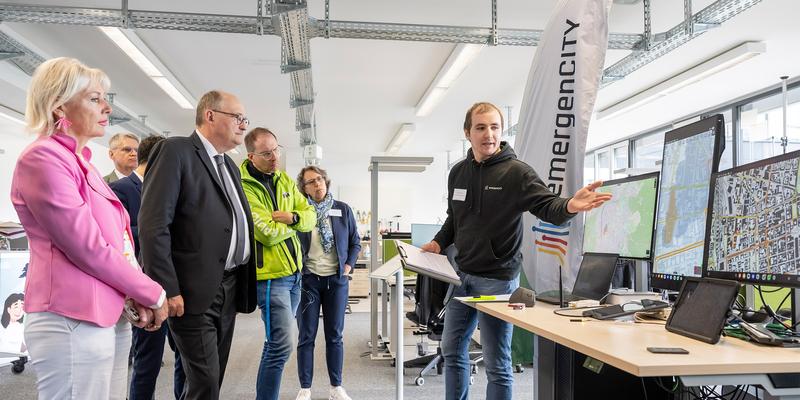
Dr. Joachim Schulze, Head of the Real-World Labs at the Digital Resilience Xchange (DiReX) Application and Transfer Center, presented the Litfaßsäule 4.0 and the eHUB real-world lab
Prof. Dr. Michèle Knodt, deputy coordinator of emergenCITY and director of the Digital Resilience Xchange (DiReX) Application and Transfer Center, added:
“To ensure that these scientific findings do not remain confined to research but instead have an impact on administration, businesses, government agencies, and society, we must put them into practice. With DiReX, we are already making a significant contribution to this. That makes all the difference in a crisis.”
Prof. Dr. Michael Muma, Principal Investigator at the LOEWE emergenCITY Center and Professor of Robust Data Science in the Department of Electrical Engineering and Information Technology at TU Darmstadt, presented an example of applied research. Together with his team, he is conducting research into the potential applications of radar systems in emergency response:
“The demonstrator shows how radar technology, combined with machine learning, can locate people even through walls and contactlessly measure vital signs such as respiratory rate. A future application in disaster situations could help locate buried individuals more quickly and detect signs of life.”
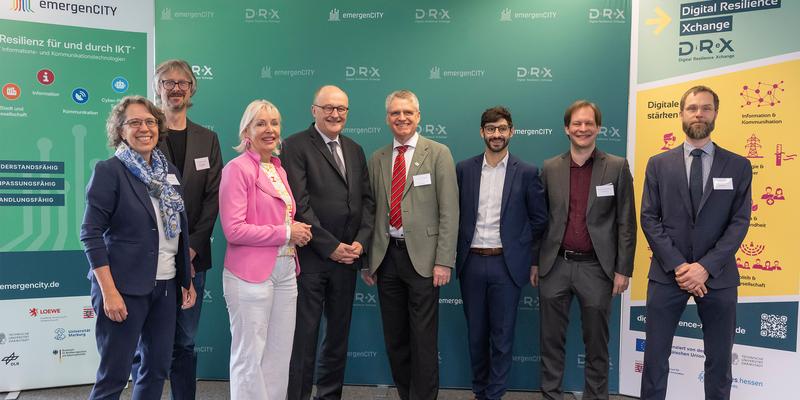
Joining the tour (from left to right): Prof. Michèle Knodt, Prof. Matthias Hollick, Hessian Minister for Digital Affairs Prof. Kristina Sinemus, Minister of State for Federal-State Cooperation Dr. Michael Meister, TU Vice President Thomas Walther, Spokesperson for Digital Affairs and Innovation for the Hessian SPD parliamentary group Bijan Kaffenberger, Prof. Björn Scheuermann, and Prof. Michael Muma
Share
Related News
emergenCITY at ICRS 2026: Advancing and Shaping Resilience Research
From Delft to Darmstadt – Seven Contributions and a Growing Role in the International Resilience...
Mar
25, 2026
On the Road with a Puzzle Book and Curiosity: Heinerblock Rally off to a successful start
On Saturday, March 21, more than 50 children set out with their parents on a...
Mar
25, 2026
ATHENE Project CYNTRA: emergenCITY scientiest Dr. Marc-André Kaufhold in a Coordinating Role
The project is developing AI-powered approaches to address online hate speech