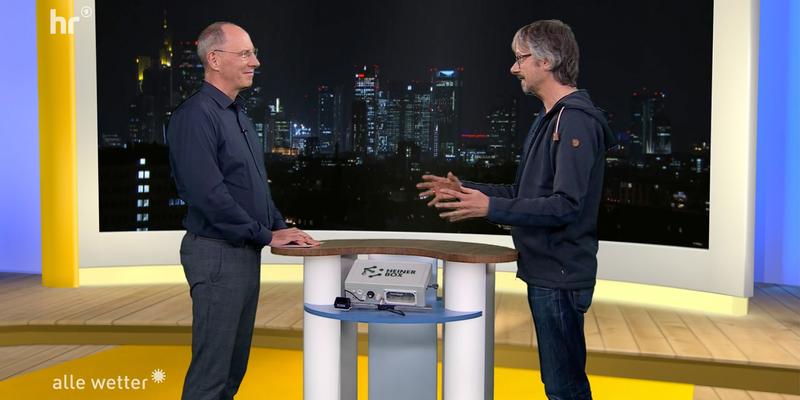
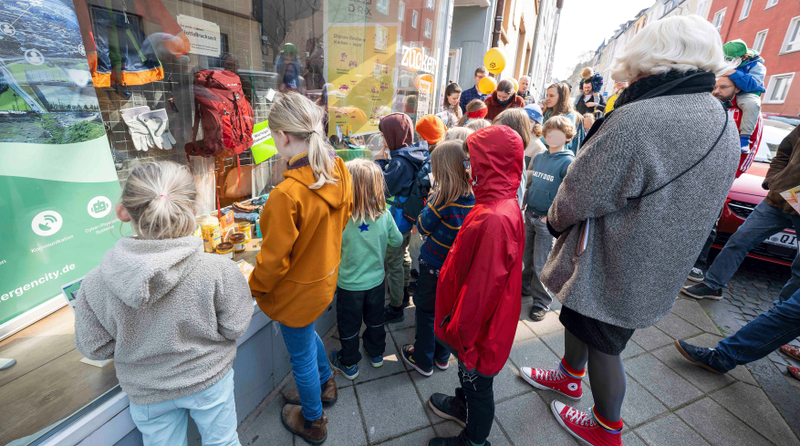
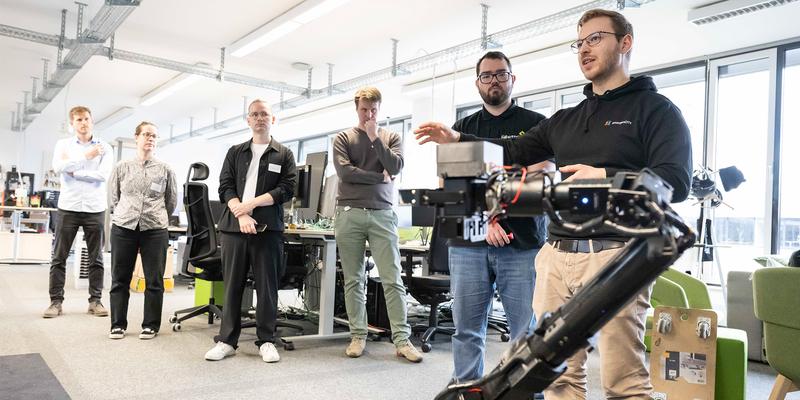
How can the Heinerbox help make cities more adaptable? Thomas Ranft, host of “alle wetter!” on Hessischer Rundfunk, asked emergenCITY scientific coordinator Matthias Hollick this question during the program on January 22. In a live interview with the host, Hollick presented the Heinerboxes, which are installed on streetlights in Darmstadt’s Martinsviertel district. He emphasized: Closely meshed recordings of environmental data such as particulate matter, temperature, air pressure, humidity, and light incidence, as well as data that provides differentiated information on traffic and noise pollution, are the key to initiating urban planning measures for a more resilient city in a second step.
Collecting environmental data comprehensively, but in a data-sparing manner
“The Heinerbox and everything we do with it has been designed from the outset with data protection and privacy in mind. We do not collect any personal data, we do not have a camera in this box”, Matthias Hollick clarified in the interview.
He used traffic data to explain how the anonymous data from the Heinerboxes still reveals what is happening in the neighborhood. A LiDAR sensor, similar to a beeping parking sensor on a car, can count cars and measure space occupation to a certain extent.
“It would be much easier with a camera”, Hollick emphasized. “But we deliberately opted for sensors that are data-sparing, meaning there is no possibility of the data being misused.”
Differentiated data for differentiated questions
The Heinerbox can also categorize the sounds in the environment. Artificial intelligence takes ten-second sections of an audio signal and determines whether a sound is, for example, a dog barking, a siren, or children screaming.
“The audio section is then immediately deleted and never leaves the box. But we know afterwards that there is an 80 percent probability that it was a dog barking”, Hollick explained.
Not all noise is the same. More people’s noise, for example, could also be a positive effect of changed car traffic management. Hollick emphasized the collaboration with other research groups and the city on this point and highlighted another possible function of the Heinerbox: In the future, the box could also provide an emergency network without electricity, continuing to provide information even if other communication channels for authorities or the fire department fail.
“alle wetter!” is a service magazine covering weather and climate issues, which airs on weekdays between 7:15 p.m. and 7:30 p.m. on Hessischer Rundfunk television. The January 22 broadcast, featuring a four-minute interview with Matthias Hollick starting at minute 8:00, is available here in the ARD media library.