Dec
11, 2025
From Bachelor’s Internship to Serious Game
Developer Jakob Huth talks about challenges, ideas, and plans for the future



Developer Jakob Huth talks about challenges, ideas, and plans for the future
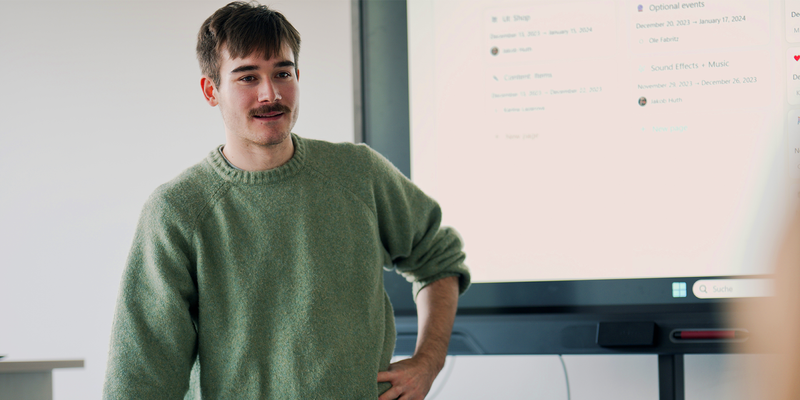
Krisopolis is now nearing the end of its development phase. The serious game began around two years ago in the form of a call for applications for a bachelor’s internship, which emergenCITY employees Joachim Schulze, Nadja Thiessen, and Julius von Willich offered as an interdisciplinary collaboration. The idea was to create a game that would give people from all walks of life a better understanding of disaster control: the fictional city offers an opportunity to overcome a wide variety of crises and gain experience for real-life emergency situations.
The students, Jakob Huth, Karina Miroslavova, Ole Fabritz, Michelle Geisler, and Marcos Rizigmursal, initially had six months to design the foundations of the game. The plan was to then have a professional studio continue working on it – but the group made much more progress in development than expected and is still working on parts of the implementation and release today. Jakob Huth, a student of cognitive science at TU Darmstadt, is one of them. To get to know this person behind the scenes a little better, emergenCITY introduces him in an interview:
Which aspect of game development do you enjoy the most? And the least?
It’s always fun when it works or when you have a good idea. Of course, searching for bugs is annoying at first, but it’s all the better when you find the bug. You always have to work for a real reward. When you want a new character, a new dialogue system, or a change of location, you’re always faced with a mountain of work at first, but it can be a lot of fun to implement and abstract.
How did you feel when you were able to actually play the game yourself for the first time?
I don’t really remember. A while ago, I played an earlier version and realized how much has happened since then, but when you’re programming, you don’t notice this gradual transition. It was very nostalgic, but also somehow reassuring to see how much we’ve accomplished.
What should Krisopolis trigger in the player – or leave them with?
Preparedness! The goal of the game is to get people to think about what they do and how they do it. It’s meant to stimulate thought. When you talk to people at conferences and such, you notice how it does that: they tell you about the gas stove they already have in their apartment for emergencies. But of course, it should also be fun. There’s a lot of tactics involved, but there’s also an exploration aspect.
Are there elements in Krisopolis that others might not notice, but that are very important to you?
There are many things in the background that players don’t really see. There were many changes to the dialogue system and items, and a lot was exported to other file formats that allow you to work more efficiently and change things.
Is there a story behind Friedel?
Friedel was Mickey’s idea, but animals are always cute. Friedel quickly became a mascot. Mert’s cat, Momo, is based on my own cat. She often jumped on the table during meetings and has now become a permanent part of the game.
Do you have ideas for more games?
In the direction of Krisopolis, there are of course also special situations in which crises can arise. For example, at a festival – how do you behave there in emergency situations? There has already been a meeting to explore the idea a little. Then, at trade fairs, people like to make their own suggestions and ask if they could perhaps be implemented – but at some point I would like to implement my own game. In any case, I know that I want to give the player as few guidelines as possible and include some magic.
Would you like to stay in this industry afterwards?
I’m really thinking about it right now. It’s incredibly fun to work in a team, make music, and think about the user’s perspective and experience. Games combine a lot of different things. It’s a cool idea, but right now I want to finish my bachelor’s degree first.
And after your master’s? I don’t know. Programming games can also be a hobby. That way, you have the advantage of less uncertainty; you’re not dependent on the popularity of a project. If it’s well received, you can switch to full-time. But I’d prefer to continue working in a team. I’m always motivated after meetings: there’s still so much to do, so much you can do! There are so many ideas!
If you had to choose a different profession, what would it be?
At the moment, I’d most likely choose science. But what does a career in that field look like? You do your master’s degree, then somehow your doctorate, and that opens up many paths. Only… which one do you take? I’ll probably take it one step at a time for now and try out what I like. Where I do my master’s degree could be very decisive in terms of direction. I’d like to pursue computer science more, but the interdisciplinary aspects of game development with music and UI design are also important to me. Artificial intelligence is also very interesting… there are many possibilities.