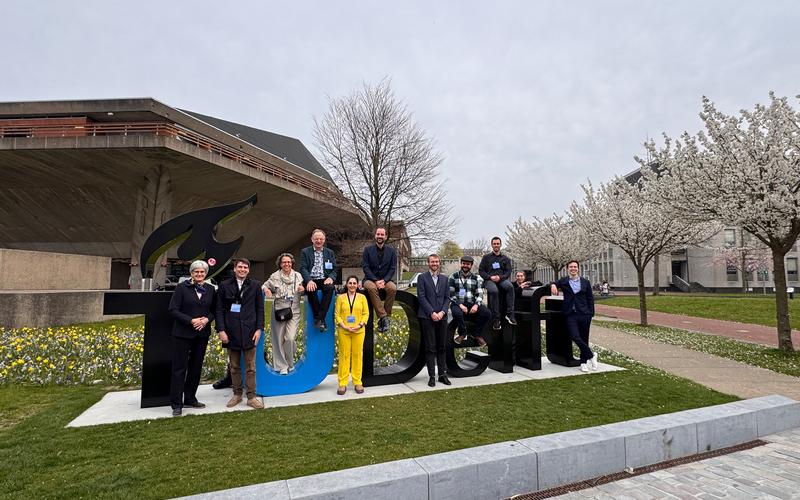
March 25, 2026 – From March 23 to 25, researchers from multiple countries gathered at Delft University of Technology for the International Conference on Resilient Systems (ICRS 2026). Under the theme “Resilience in an Age of Disruption,” the conference focused on how societies, infrastructures, and technical systems can better prepare for, respond to, and recover from crises. emergenCITY contributed actively to the scientific program and helped shape the conference.
Christian Reuter, Deputy Coordinator of the LOEWE Center emergenCITY, and Max Mühlhäuser, Distinguished Emeritus, have been members of the Scientific Organizing Committee since 2024. The conference was co-organized by Technical University of Darmstadt and the DLR Institute for the Protection of Terrestrial Infrastructures, together with the 4TU Centre for Resilience Engineering, the Singapore-ETH Centre, and the ETH Zurich.
Seven Contributions Across Critical Topics
Researchers from emergenCITY and DiReX contributed seven presentations covering critical infrastructure systems, hydrological risk modeling, distributed computing, and digital approaches to crisis management.
A central focus was placed on water infrastructure and its resilience under disruption. Kevin T. Logan presented two complementary studies, examining how consumer behavior influences the robustness of water distribution systems and experimentally evaluating design and operational strategies under conditions such as leakage, blockage, and pump failures. Within the same area, Michaela Leštáková focused on monitoring methods for water supply systems, improving system observability and detection of internal states in complex infrastructures. Jonathan Sattler addressed uncertainty in water demand estimation, highlighting challenges in modeling consumption under variable and unpredictable conditions. Extending into hydrological applications, Mahshid Khazaeiathar presented fuzzy logic-based approaches for short-term flow forecasting using the Schwarzbach catchment as a case study, supporting robust and interpretable predictions for data-scarce environments and early warning systems.
Beyond water-related systems, Markus Sommer introduced REC, a resilient edge computing platform for emergency scenarios with limited or unavailable cloud connectivity, enabling distributed computation and local data processing. In crisis communication, Joachim Schulze presented Litfaßsäule 4.0, an energy-autonomous warning infrastructure designed to maintain public information during prolonged power outages. Finally, Tobias Gebhard presented the NEXUS demonstrator, an integrated simulation environment connecting electricity, water, and transportation systems, supporting analysis of interdependencies and contributing to digital twin approaches for urban crisis management.
Next Stop: Darmstadt
The next ICRS conference will take place in Darmstadt, organized by DiReX. emergenCITY’s strong presence at the 2026 conference highlights its growing leadership in the field and signals its continued role in shaping the future of resilience research worldwide.