Field day showcases innovations from emergenCITY research on resilience
How can renewable energy be stored in metals? How can energy-self-sufficient smart homes increase resilience during a crises situation? How do rescue robots support emergency services in disasters? Researchers from the LOEWE Center emergenCITY and the DiReX (Digital Resilience Exchange) Application and Transfer Center answered these and other questions on January 29 at a Field Day entitled “Future Technologies for Energy and Security – Research Meets Practice.”
The event was initiated by the Erasmus+ ENGAGEgreen project and the Mercator Science-Policy Fellowship Program of the Rhine-Main Universities, which have set themselves the task of promoting dialogue between science and politics, administration, NGOs, and the media. More than 30 participants from business, administration, politics, and authorities as well as organizations with security responsibilities, including speakers from state and federal ministries and offices, state parliament representatives, representatives of local authorities, police and fire departments, and companies accepted the invitation.
Energy storage and smart homes of the future at the TU Lichtwiese campus
The day began with an insight into the Metal Energy Hub, which researches metals such as iron and aluminum as climate-neutral energy sources and aims to put them into application.
Joachim Schulze, research assistant at emergenCITY and head of real-world laboratories at DiReX, then presented the eHUB, an energy-self-sufficient smart home. As an island-capable building, the eHUB can supply itself in the event of a power failure and share the electricity generated by photovoltaics with parts of the neighborhood and critical infrastructures. In addition, eHUBs could serve as contact points for the population in crises, thus supporting emergency communications.
“In this way, a fallback system could be created in cities in the event of a blackout that requires neither additional infrastructure nor additional space,” said Joachim Schulze.
Strengthening digital resilience with rescue robot, city model, and the Litfaßssäule 4.0 advertising column
After a joint lunch, Michèle Knodt, deputy coordinator of emergenCITY and director of DiReX, gave a presentation on further scientific projects related to digital resilience.
She emphasized: “Power outages such as those in Berlin show how vulnerable our critical infrastructures are and how urgent it is to further strengthen digital resilience now.”
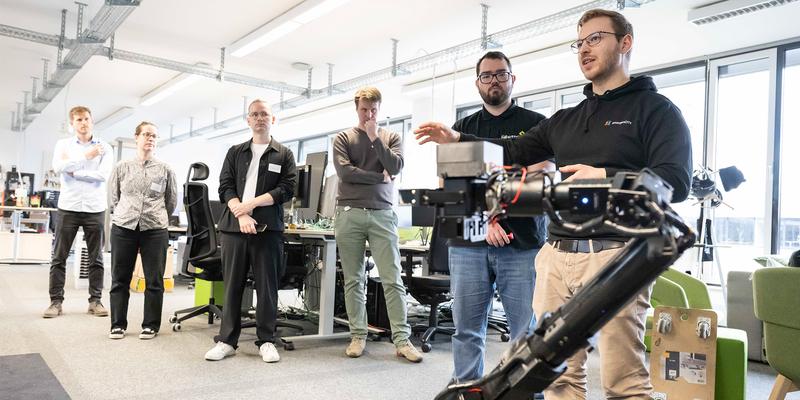
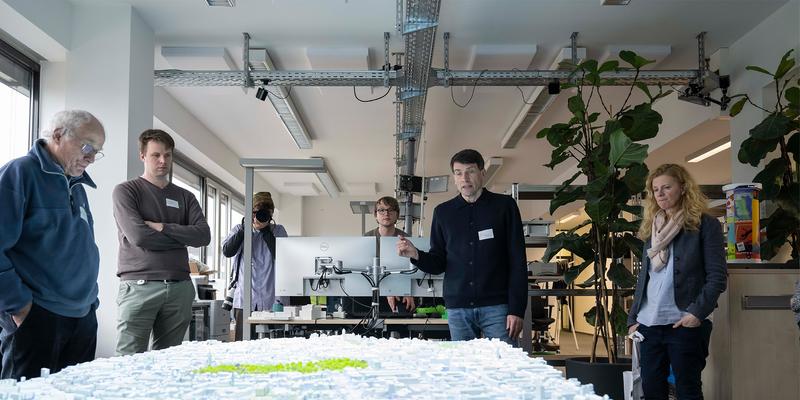
Afterwards, emergenCITY lab engineer Julian Euler and Joachim Schulze showed participants the digital city model in the emergenCITY lab, which uses animated projection to illustrate data on a 3D model of Darmstadt. With the Litfaßsäule 4.0 model, Joachim Schulze explained how an attachment for existing advertising columns can display warnings and information during a prolonged power outage thanks to photovoltaics and fuel cells. Stefan Fabian, research assistant at emergenCITY, also demonstrated the Athena rescue robot, which can autonomously explore rough terrain.
Positive response to the practical insights
“I was particularly impressed by the great potential of digital resilience as an important element for overcoming current and future challenges,” summarized participant Christian Bachmann from the Coordination Office for Network and Communication Resilience at the Broadband Office of Hesse after the event.
Joachim Schulze (second from right) showed participants the 3D city model of Darmstadt in the emergenCITY Lab, onto which various data can be projected.
Share
Related News
Distinguished Lecture with Hans Rudolf Heinimann
As part of this year’s emergenCITY Week, a Distinguished Lecture will be held featuring Prof....
Mar
29, 2026
Events
Ruzena Bajcsy Lecture 2026 with Tina Comes: Navigating Uncertainty – AI and Decision Support for Crisis Management
Lecture on AI and decision support for crisis management, including the presentation of the Female...
Mar
27, 2026
Events
On the Road with a Puzzle Book and Curiosity: Heinerblock Rally off to a successful start
On Saturday, March 21, more than 50 children set out with their parents on a...